| Model | Cores | Threads | Frequency | Turbo Frequency | L3 Cache | TDP | Price |
| FX-8150 | 8 | 8 | 3.6GHz | 4.2GHz | 8MB | 125w | $245 |
| FX-8120 | 8 | 8 | 3.1GHz | 4.0GHz | 8MB | 125w | $205 |
| FX-6100 | 6 | 6 | 3.3GHz | 3.9GHz | 6MB | 95w | $165 |
| FX-4100 | 4 | 4 | 3.6GHz | 3.8GHz | 4MB | 95w | $115 |
Showing posts with label Bulldozer. Show all posts
Showing posts with label Bulldozer. Show all posts
Thursday, 27 October 2011
AMD FX-Series Bulldozer Specifications Price and Info
Hey everyone, This post is going to be a simple table that shows you the specifications of the new AMD FX-Series Bulldozer CPU's


Saturday, 22 October 2011
The Bulldozer Review: AMD FX-8150 Tested
AMD has been trailing Intel in the x86 performance space for years now. Ever since the introduction of the first Core 2 processors in 2006, AMD hasn't been able to recover and return to the heyday of the Athlon 64 and Athlon 64 X2. Instead the company has remained relevant by driving costs down and competing largely in the sub-$200 microprocessor space. AMD's ability to hold on was largely due to its more-cores-for-less strategy. Thanks to aggressive pricing on its triple and hexa-core parts, for users who needed tons of cores, AMD has been delivering a lot of value over the past couple of years.
Recently however Intel has been able to drive its per-core performance up with Sandy Bridge, where it's becoming increasingly difficult to recommend AMD alternatives with higher core counts. The heavily threaded desktop niche is tough to sell to, particularly when you force users to take a significant hit on single threaded performance in order to achieve value there. For a while now AMD has needed a brand new architecture, something that could lead to dominance in heavily threaded workloads while addressing its deficiencies in lightly threaded consumer workloads. After much waiting, we get that new architecture today. Bulldozer is here.
 It's branded the AMD FX processor and it's only available in a single die configuration. Measuring 315mm2 and weighing in at around 2 billion transistors (that's nearly GPU-sized fellas), Bulldozer isn't that much smaller than existing 45nm 6-core Phenom II designs despite being built on Global Foundries' 32nm SOI process. Both die area and transistor count are up significantly over Sandy Bridge, which on Intel's 32nm HKMG process is only 995M transistors with a die size of 216mm2. This is one big chip.
Read More - http://www.anandtech.com/show/4955/the-bulldozer-review-amd-fx8150-tested
Related Articles;
Recently however Intel has been able to drive its per-core performance up with Sandy Bridge, where it's becoming increasingly difficult to recommend AMD alternatives with higher core counts. The heavily threaded desktop niche is tough to sell to, particularly when you force users to take a significant hit on single threaded performance in order to achieve value there. For a while now AMD has needed a brand new architecture, something that could lead to dominance in heavily threaded workloads while addressing its deficiencies in lightly threaded consumer workloads. After much waiting, we get that new architecture today. Bulldozer is here.
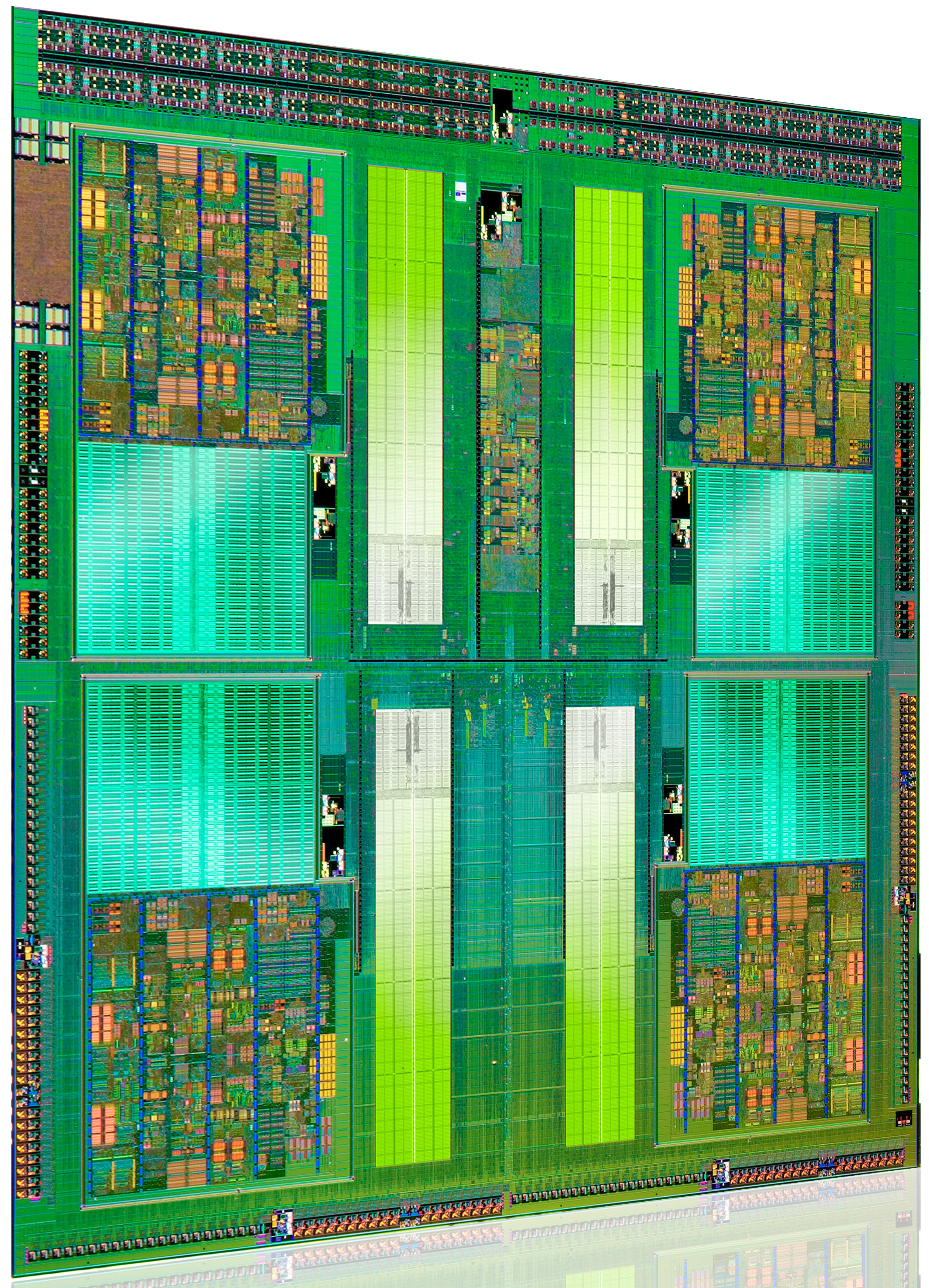
Read More - http://www.anandtech.com/show/4955/the-bulldozer-review-amd-fx8150-tested
Related Articles;
AMD Llano A8-3850 vs Intel Core i3 210
Saturday, 6 August 2011
AMD to Launch Next-Generation Opteron “Bulldozer” Microprocessors in Late September – Report.
Advanced Micro Devices plans to formally introduce its next-generation Opteron central processing units (CPUs) code-named Interlagos and Valencia on Monday, September 26, 2011. The highly-anticipated introduction is expected to mark a new beginning in AMD’s history as the new chips feature the company’s first new micro-architecture in eight years.
AMD is eyeing the September 26 release date for its new “Valencia” Opteron 4200-series chips with six or eight cores as well as “Interlagos” Opteron 6200-series microprocessors with eight, twelve or sixteen cores, according to a report from PCMag, which cites a source familiar with the company's product roadmap. AMD expects new chips to offer 35% higher performance compared to existing AMD Opteron chips with up to twelve cores.
AMD needs the new Bulldozer-based microprocessors badly as its share on the server market declined in Q2 2011 to 5.5% down from 25.9% in Q2 2006, according to IDC. At present Intel outsells AMD in terms of servers 19 to 1. It is obvious that the release of even ground-breaking chips will not allow AMD to quickly fight back the share from Intel, it will take several quarters at least. Nonentheless, the company’s shipments of Opteron central processing units will either stabilize or will even grow a bit provided that they are competitive enough.
AMD is eyeing the September 26 release date for its new “Valencia” Opteron 4200-series chips with six or eight cores as well as “Interlagos” Opteron 6200-series microprocessors with eight, twelve or sixteen cores, according to a report from PCMag, which cites a source familiar with the company's product roadmap. AMD expects new chips to offer 35% higher performance compared to existing AMD Opteron chips with up to twelve cores.
AMD needs the new Bulldozer-based microprocessors badly as its share on the server market declined in Q2 2011 to 5.5% down from 25.9% in Q2 2006, according to IDC. At present Intel outsells AMD in terms of servers 19 to 1. It is obvious that the release of even ground-breaking chips will not allow AMD to quickly fight back the share from Intel, it will take several quarters at least. Nonentheless, the company’s shipments of Opteron central processing units will either stabilize or will even grow a bit provided that they are competitive enough.
 |
| Read More Here |
Sunday, 13 February 2011
AMD Plans Extremely Rapid Transition to New Micro-Architectures, Process Technology.
Advanced Micro Devices seems to be planning extremely rapid transition of its desktop microprocessors to 32nm silicon-on-insulator fabrication process, a person with knowledge of the matter said. By the second quarter of 2012 virtually all AMD processors will be made using 32nm SOI technology and be based on new designs.
At present the absolute majority of desktop microprocessors shipped by Advanced Micro Devices are AMD Athlon II and AMD Phenom II chips in AM3 form-factor. But already in a little bit more than a year from now all the desktop chips that AMD will sell will be made using 32nm SOI process technology and will rely on code-named Bulldozer, Brazos and Llano designs, the source indicated.
Approximately 20% of AMD's desktop microprocessors in Q2 2012 will be in AM3+ form-factor and will belong to the FX family of chips, which is based on Bulldozer micro-architecture. About 10% of desktop chips will come in FT1 ball-grid-array form-factor and will therefore be based on Brazos design. The remaining 70% will be Llano accelerated processing units with two or four x86 cores as well as a Radeon HD 6000-class graphics engine in FM1 form-factor.
It is remarkable that after a number of delays AMD seems to have rather ambitious plans for the 32nm ramp. By contrast, it usually takes years for Intel Corp., the much larger rival of AMD, to transit to one micro-architecture to another or from one technology process for another.
AMD did not comment on the news-story.
www.customdesktops.moonfruit.com
http://www.xbitlabs.com/news/cpu/display/20110211103809_AMD_Plans_Extremely_Rapid_Transition_to_New_Micro_Architectures_Process_Technology.html
At present the absolute majority of desktop microprocessors shipped by Advanced Micro Devices are AMD Athlon II and AMD Phenom II chips in AM3 form-factor. But already in a little bit more than a year from now all the desktop chips that AMD will sell will be made using 32nm SOI process technology and will rely on code-named Bulldozer, Brazos and Llano designs, the source indicated.
Approximately 20% of AMD's desktop microprocessors in Q2 2012 will be in AM3+ form-factor and will belong to the FX family of chips, which is based on Bulldozer micro-architecture. About 10% of desktop chips will come in FT1 ball-grid-array form-factor and will therefore be based on Brazos design. The remaining 70% will be Llano accelerated processing units with two or four x86 cores as well as a Radeon HD 6000-class graphics engine in FM1 form-factor.
It is remarkable that after a number of delays AMD seems to have rather ambitious plans for the 32nm ramp. By contrast, it usually takes years for Intel Corp., the much larger rival of AMD, to transit to one micro-architecture to another or from one technology process for another.
AMD did not comment on the news-story.
www.customdesktops.moonfruit.com
http://www.xbitlabs.com/news/cpu/display/20110211103809_AMD_Plans_Extremely_Rapid_Transition_to_New_Micro_Architectures_Process_Technology.html
Monday, 17 January 2011
AMD's Bulldozer Microprocessors Expected to Offer 50% Higher Performance than Core i7, Phenom II Chips

The next-generation desktop central processing units (CPUs) from Advanced Micro Devices with Bulldozer micro-architecture are projected to offer around 50% higher performance compared to existing chips from AMD and Intel. While the promises seem very promising, they should be considered as extremely rough estimates.
An AMD document obtained by Donanimhaber web-site claims that an eight-core Bulldozer microprocessor offers 50% higher performance compared to quad-core Intel Core i7-950 with HT microprocessor in games, rendering and multimedia applications. The web-sites does not specify which benchmarks were used. In fact, 50% higher performance versus a quad-core chip does not seem to be bad, especially in games that do not usually take advantage of multi-core chips.
The web-site claims that AMD compares performance of the Core i7-950 with performance of AMD Phenom II X6 1100T chip, which is considerably slower than its rival, according to performance tests conducted by X-bit labs. It is unclear whether AMD showed the model 1100T being slower or faster than the i7-950. Test settings were not revealed. Typically, AMD publishes so-called "simulated benchmark results".
Rumours published earlier this month suggested that AMD plans to return the FX products family with extreme performance. Indirectly, this information confirms very high performance of new microprocessors from AMD.
Engineering samples of code-named Zambezi (desktop Bulldozer) chips became available for AMD's partners for testing in December, 2010. Production candidates should be ready by February '11 and the initial production of the company's first desktop microprocessors powered by the long-awaited Bulldozer micro-architecture is scheduled to start in April next year. Probably, the launch of the chip will occur around the same timeframe.
Eight-core Zambezi features four dual-core Bulldozer modules, each of which is believed to have 2MB of shared level-two cache, that will share 8MB L3 cache. In total, the whole chip will pack in whopping 16MB of SRAM, a 77% increase from the current six-core microprocessors that have 9MB of cache in total. Clock-speeds of the chip may be as high as 3.50GHz or even higher.
The first Zambezi microprocessors to be launched are expected to be eight-core products with 95W and 125W thermal design power as well as 8MB L3 cache. Later in the second quarter of 2011 AMD, according to sources with knowledge of the company's roadmap, will release six-core chips with 8MB L3 cache and four-core products with 4MB cache. All of the processors will feature TurboCore 2.0 technology, dual-channel DDR3 memory controller with up to 1866MHz memory support and will be compatible with AM3+ mainboards.
AMD did not comment on the news-story.
www.customdesktops.moonfruit.com
Image From: http://www.flickr.com/photos/aaronage/4579463630/
Subscribe to:
Posts (Atom)