Showing posts with label Graphics. Show all posts

Monday, 9 January 2012

AMD Release the HD 7970 3Gb Graphics Card

The graphics giant AMD have released the new AMD HD 7970 offering amazing performance on a 28nm GCN architecture. They are currently priced at around £450 which is a very high price to pay but the performance that you get is very very good. The 3Gb of GDDR5 running at 5500MHz allows a bandwidth of 264GB/s which is some serious performance. The core of the graphics card runs at a stock speed of It supports a maximum display resolution of 4096x3112. You can find the specifications of the card here

The HD7970 looks like most of the cards that AMD have made since the 5-series having an exhaust port on the back and a blower fan on the inside. These fans are usually very loud and can be a bit annoying. Often companys such as sapphire, sparkle, xfx, and gigabyte will take the cards and fit an after market uprated quiet cooler but so far there is no sign of this happening. The 28nm architecture of the new 7970 will however be cooler running and most likely quieter than the 5 and 6 series cards that were produced by AMD using a bigger architecture.

AMD Radeon HD 7970 Stock Card

AMD Radeon HD 7970 Quad Crossfire Setup

Overall the performance of these cards is a massive improvement over most of the ones currently available and being the 7970 there is always space for a 7990 to be released yet. Roumor has it that is will cost around $850 which is a very high price but it will have some very good performance.

Wednesday, 20 July 2011

Budget HD HDMI Graphics Cards - 2011

Hey everyone, In this post I am going to be looking at cheap budget graphics cards. Many people don't use computers for gaming and so don't need very powerful graphics cards however if you occasionally want to watch a bit of HD video and your onboard graphics isn't quite up to it then these cards will do well for your situation. They are cheap and quiet and will play HD video. All the cards that I am going to look at have a native HDMI output.

AMD Radeon HD 5450 512mb
The Radeon HD 5450 is a very capable cheap graphics card. It will easily run HD video. You can get this cheap card at an amazing £23 ($37) which is an amazing price. You can find it here. It's specifications are as follows;
  • Engine Clock - 650Mhz
  • Memory Clock - 800Mhz
  • Memory Interface - 64bit
  • Benchmark Score - 303
Overall this is a very capable graphics card for running HD video and even some light gaming. Having looked on youtube there are a fair few people playing games with this card which amazed me to be honest. Another good thing about this card is that it only needs a 350-400w PSU for it to run correctly so quite a few branded computers could have this card fitted as an upgrade. The benchmark score for this card is not bad at all and you can tell that it has a good high clock speed from those results.

AMD Radeon HD5450 512Mb
Nvidia Geforce 8400GS 512Mb
The 8400GS has been around for some time now but at just £23($37) it is still worth a look at. You can find this card here it has the following specifications;
  • Engine Clock - 450Mhz
  • Memory Clock - 800Mhz
  • Memory Interface - 64-bit
  • Benchmark Score 139
Overall this isn't as well setup for HD video playback as there is a much lower clock speed than on the 5450. This means that you will most likely end up with slower play back and sometimes missed frames. I wouldn't recommend this for HD film watching but if you want a graphics card just for the windows aero theme and want to take a bit of load of the CPU and RAM in the computer then this cheap card will do the trick. The low benchmark score would most likely have been down to the really low Engine clock speed.
Gigabyte Geforce 8400GS 512Mb

Nvidia Geforce 210 512Mb
The Nvidia Geforce G210 is a higher performance card from Nvidia than the 8400GS. It costs £26 ($42) which is a bit more than the other 2 cards that I have looked at so far. You can find the card here. It comes with the following specs;
  • Engine Speed - 520Mhz
  • Memory Speed - 1.2Ghz
  • Memory Interface - 32-bit
  • Benchmark Score - 203
The clock speed of this graphics card isn't quite as high as the clock speed of the 5450 but it is faster than the 8400GS. The memory speed is where this card stands out with a rating of 1.2Ghz a full 50% faster than the other 2 cards. However the card is really let down by the tiny 32-bit memory interface which would most likely take away whatever performance the extra 50% more Mhz the RAM gave. Overall yes you could most likely play HD video on this card but if it was me I would rather spend a few more £/$ and get something a bit more pokey. The benchmark of this card is in the middle of the other 2 cards which proves that it really isn't worth the extra couple of pounds/dollars.

EVGA Geforce G210 512Mb

AMD Radeon HD 6450 512Mb
The new AMD Radeon 6-Series has higher performance and is DirectX11 ready which means that it is ready for all the new games for the next couple of years. This card costs just over £33 ($53) You can find this card here it has the following specifications;
  • Engine Clock - 625Mhz
  • Memory Clock - 1334Mhz
  • Memory Interface - 64-Bit
  • Benchmark Score - 376
These numbers look rather promising for playing HD video. They have the high clock speed that is needed and also the good RAM speed as well. The memory interface is nothing to rave about but it will do for most peoples needs when running Windows Aero and HD video. Overall not a bad card for the price and a good benchmark score that is higher than all the cards before it. The high memory speed matched with the good memory interface here really shows in the performance of the card.
Sapphire Radeon HD6450 512Mb


Nvidia Geforce 9500GT 512Mb
The Nvidia Geforce 9500GT is just over the £35 limit that I set for this post. This card has been around for a while but it not massively out of date really. You can find the card here. It has the following specifications;
  • Engine Clock - 550Mhz
  • Memory Speed - 667Mhz
  • Memory Interface - 128-Bit
  • Benchmark Score - 352
This card may not have the fastest memory or engine clock but it has double the maximum memory interface speed than all the other cards.This card however costs more than the 6450 but has returned a slower benchmark speed so it isn't really worth considering it if it costs more and is slower. However I do believe that this would most likely be slightly better at gaming due to the higher memory interface speed.
Inno3D 9500GT 512Mb
Overall then the best card that you can currently get under £35 ($56) is the AMD Radeon HD6450 with it's amazing benchmark score of 376 and the highest memory speed it is the best card for watching HD video on at a budget. Thanks for reading. Below are some related articles;
Budget CPU Coolers Reviewed

Friday, 15 July 2011

AMD A-Series APU Dual Graphics Gaming Performance

In this video we see how adding an AMD Radeon graphics card to an AMD 8-Series CPU can make gaming frame rates improve dramatically by running AMD's Crossfire technology with the APU helping out the graphics card in gaming.
As you can see AMD have managed to make gaming a relatively cheap thing since they have bought out the APU and the budget line of 6000 graphics cards.

Related Articles;
AMD A-Series APU Overclocking and Gaming Performance
AMD Llano A8-3850 vs Intel Core i3 2120

Thursday, 14 July 2011

HIS Unveils the New 6970 IceQ Mix Flexible-Eyefinity Graphics Card

Recently HIS have released their much awaited IceQ turbo and IceQ standard models of the 6970. HIS always seem to make a good product better and this is exactly what they have done with the AMD Radeon 6970 graphics card. HIS just launched HIS 6970 IceQ Mix, providing an easier way for gamers to run both AMD & NVIDIA GPU and enable Eyefinity via HDMI output

Included in the box of this graphics card is also a Dirt 3 game coupon and 4 cables, Standard Display Port, HDMI to DVI, Standard HDMI cable, and a DVI to VGA cable.

In the past, you need to crossfire your card with the same AMD Series model. But HIS 6970 IceQ Mix grants you power to enjoy the benefits of running both AMD and NVIDA GPU in the same system.

Furthermore, most graphics cards require connecting the DisplayPort output or using the active DisplayPort adapter in order to perform Eyefinity. It is not only costly but also inconvenient.

With this HIS 6970 IceQ Mix, you can easily set up Eyefinity with ANY of three outputs or All five outputs for multi-display gaming.

HIS HD 6970 IceQ Mix Key Features and Advantages:
  • Mix Eyefinity – AMD’s Eyefinity is enabled via HDMI without using expensive Display Port monitors and Active Adapters. Eyefinity is also enabled via HDMI to DVI adaptor.
  • Mix GPU – Allow running both an AMD and NVIDIA GPU in the same system to enjoy the benefits of both graphics features and performance.
  • IceQ Technology - Cool air is drawn from both sides of the fan to thereby enhance the cooling efficiency, directly exhausts hot air out of PC case.
  • -23°C Cooler - HIS 6970 IceQ Series is over 23°C cooler than the Reference Cooler.
  • Quieter – HIS 6970 IceQ Series is quieter than the Reference Cooler, significantly reducing noise level.
Related Articles;

AMD Radeon 6800 and 6900 Series graphics cards get price drops
ASUS Prepares to Unleash its Radeon 6970 DirectCU Graphics Card

    AMD Radeon 6990M Introduction and Graphics Benchmark

    This video is a quick demonstration and description of how the new Alienware M18X laptop uses the power of the AMD Radeon 6990M and 2Gb of GDDR5 RAM to produce the best gaming laptop in the world. The 6990M is the fastest single mobile graphics card on the market at the moment and this laptop can utilize two of them to produce mega performance in games and HD video.
    This laptop surely is a proper gaming machine and with such portability I am very impressed with the power they have got in this thing.

    Related Articles;

    AMD Raises the Mobile Performance Bar with Radeon HD 6990M


    Wednesday, 13 July 2011

    AMD Llano A8-3850 vs Intel Core i3 2120

    I have recently been looking at the performance of the new AMD Llano CPU's. Having looked at a few benchmark videos and bench mark results I decided to compare an Intel CPU and an AMD CPU that both cost the same amount of money (well as close as I could get on the eBuyer website)
    The two CPU's I chose were the AMD Llano A8-3850 and the Intel Core i3 2120 CPU. Both of which are of the latest CPU's from each company and both cost around the same sort of price. The intel CPU being £6 more. Here are the 2 CPU's on the eBuyer website;

    http://www.ebuyer.com/product/272282
    http://www.ebuyer.com/product/254978


    AMD Llano A8-3850 Specifications
    Core Speed - 2.9Ghz
    Number of cores - 4
    Number of threads - 4
    Cache - 4mb
    Intergrated Graphics - 6550D
    Graphics Frequency - 600MHz

    Intel Core i3 2120 Specifications
    Core Speed - 3.3GHz
    Number of core - 2
    Number of threads - 4
    Cache - 3Mb
    Intergrated graphics - Intel HD 2000
    Graphics Frequency - 850Mhz

    As you can see the AMD CPU has 4 real cores whereas the Intel CPU only has 2 real cores and Hyper Threading. This might make a noticeable difference in the CPU benchmarks later on.

    I first went on the the CPU benchmark site called www.cpubenchmark.net this site has bench marks for pretty much every CPU that there is and is based on results that are got from it's own benchmark program called Passmark Performance test. Every time someone runs the program it uploads the results from the CPU and graphics card tests to this website. These are the benchmark results for both of the CPU's. Bearing in mind that the graphics side of the chips are not taken into account on this test.

    AMD Llano A8-3850 - 4786
    Intel Core i3 2120 - 3943

    As you can see the AMD is already way ahead with basic CPU performance. It is around 21% faster for £6 less cost. This clearly makes the A8-3850 a better option for just CPU performance.

    Now I am going to look at the graphical performance of each CPU. I couldn't find much data really about the graphics performance however I did find a couple of videos of each CPU running  games. (I know the intel one is based on the 2100 but that is because I couldn't find 2120 specific results)

    Here is the AMD Llano A8-3850 running Crysis 2 without the aid of a graphics card


    Here is the Intel Core i3 2120 running Dirt 3 without a graphics card


    As you can see the Intel CPU is running the graphics on low with a resolution of only 1024x768 which is pretty feeble. The AMD A8-3850 is running Crysis 2 (known for being demanding) It is also running a second benchmark program in the background of the game loading 2 of the cores to 100% as well.

    Overall I think that AMD have really hit the spot with the new APU series of processors that they have developed. They are definatly cheaper than the Intel equivalent and also seem to offer some very good performance as well. If AMD carry on this way with there higher performance CPU's in the future I am pretty sure that they will earn a lot of money of this great design.

    Tuesday, 12 July 2011

    AMD Raises the Mobile Performance Bar with Radeon HD 6990M

    Introducing the Radeon HD 6990M

    The battle for graphics supremacy has been going for well over a decade now, with several casualties of war along the way (RIP 3dfx, Trident, S3, etc.). The primary competitors continue to be NVIDIA and AMD, and with NVIDIA having recently reclaimed the single GPU performance crown on both desktops and laptops with their GTX 580/580M, it’s time for AMD to respond. We’re not presenting any details for next generation desktop parts at present, and in fact the HD 6990M isn’t much of a surprise, but either way AMD is ready to release the details of their next mobile GPU.

    The price/performance ratio is actually pretty similar between AMD and NVIDIA mobile GPUs, and both have a decent number of design wins with notebook ODMs. The current mobile performance crown goes to NVIDIA’s recently launched GTX 580M, but along with the performance crown comes a hefty price and performance bill that needs to be paid. AMD’s top mobile part prior to today’s announcement is the 6970M, which is basically a lower clocked version of the desktop Barts core with some of the Stream processors disabled (essentially a mobile HD 6850). Our testing has shown the 6970M to offer just slightly less performance on average compared to the GTX 485M, but interestingly enough NVIDIA managed to use less power in low/idle loads than AMD. Of course, even the HD 6970M is a trimmed Barts core, and there’s still the desktop 6950/6970 Cayman core that has yet to see a mobile variant, which brings us to today’s announcement.

    If you were hoping to see a truly crazy mobile GPU running off the Cayman architecture, we’re unfortunately not getting that. Unlike the desktop 6990, we’re also not talking about a dual-GPU in a single card solution. Instead, the HD 6990M will be a full Barts core, with all 1120 shaders enabled. (The closest desktop equivalent is the HD 6870, which comes clocked at 900MHz, 25% higher than the 6990M.) Besides the now-standard DX11 support that AMD has been shipping since the first HD 5000 parts, 6990M also includes HD3D (stereoscopic 3D), OpenCL 1.1, and DirectCompute 11 support. AMD groups many of the features under the umbrella of "AMD App Acceleration", though there's technically nothing new here as all the 5000M and 6000M DX11 parts use the same drivers and support nearly the same features.

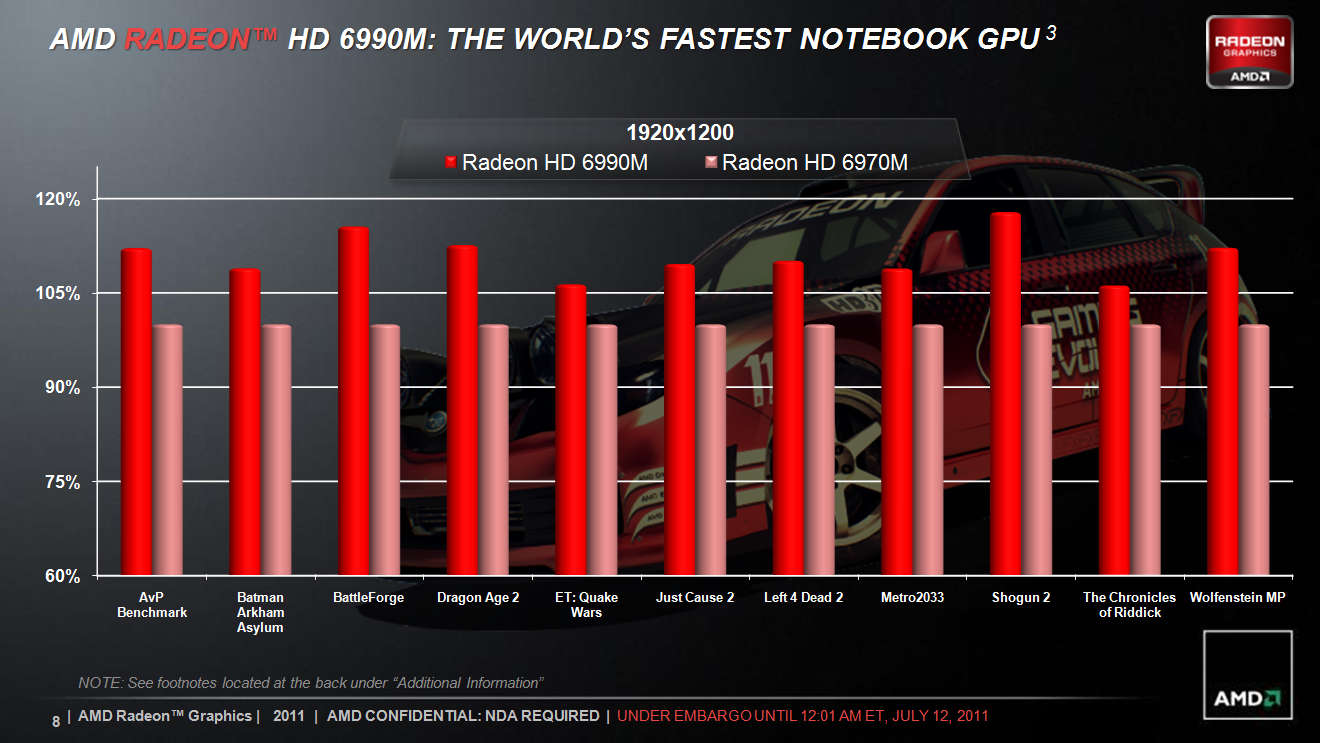
    Looking at the mobile parts, the shader count gives the 6990M an immediate 17% boost in performance relative to the 6970M, and with a slightly higher cores clock as well (715MHz on the 6990M vs. 680MHz on the 6970M), we’re looking at up to 23% higher performance than the 6970M. Both the 6970M and 6990M continue to feature 3600MHz GDDR5 memory, although the 6990M comes with 2GB instead of 1GB. AMD also enabled OverDrive up to 740MHz for the 6990M if you want to try some quick overclocking. Here’s how performance between the AMD parts stacks up, according to AMD’s internal testing (using a desktop 3.4GHz Phenom II CPU):


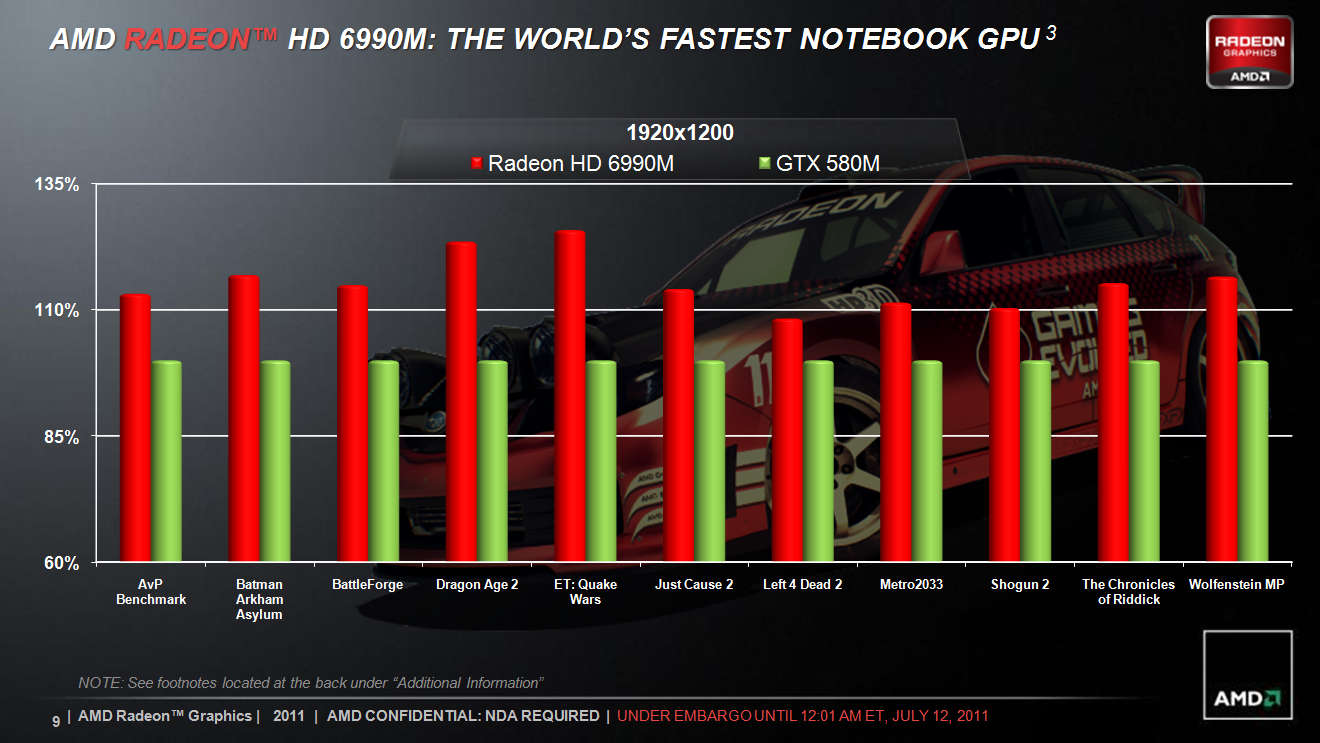
    On the other side of the fence, NVIDIA’s GTX 580M has the same number of CUDA cores as the GTX 485M (384 cores), but with an 8% increase in clock speed. (The closets desktop equivalent is the GTX 560 Ti, which comes clocked 37% higher than the 580M.) Our earlier testing of the 485M and 6970M resulted in nearly identical average gaming performance across eight tested games, with both sides winning a few titles. In theory, then, HD 6990M should retake the mobile performance crown given the greater increase in compute and clock speeds relative to the second-tier parts. The following slide uses simulated performance (e.g. a downclocked desktop GTX 560 Ti GPU running at mobile speeds and with only 1GB GDDR5, again with a 3.4GHz Phenom II CPU), so take these results with a grain of salt:


    Both the AMD and NVIDIA parts should be plenty fast for 1080p mobile gaming, so the real question is more likely to be who offers the best overall value. Sure, value in a gaming notebook is something of an oxymoron, but unless you absolutely need CUDA/PhysX support on the NVIDIA side or are looking at Bitcoin mining on the AMD side, performance is going to be close enough that pricing will sway the vote. Availability of the 6990M starts today, with the Alienware M18x coming in both single and CrossFire configurations. Clevo will also support the HD 6990M in their P170HM, P150HM, and X7200 notebooks, which means we’ll see whitebooks from the usual suspects like Eurocom, AVADirect, and others. Here's AMD's complete high-end mobile GPU lineup:

    AMD Mobility Radeon 6800M and 6900M Lineup

    Radeon HD 6990M Radeon HD 6970M Radeon HD 6950M Radeon HD 6870M Radeon HD 6850M
    Model Name (Code Name) Blackcomb Pro (Barts) Blackcomb Pro (Barts) Blackcomb Pro (Barts) Granville Pro (Juniper) Granville Pro (Juniper)
    Stream Processors 1120 960 960 800 800
    Texture Units 56 48 48 40 40
    ROPs 32 32 32 16 16
    Core Clock 715MHz 680MHz 580MHz 675MHz 625MHz
    Memory Clock 900MHz (3.6GHz) GDDR5 900MHz (3.6GHz) GDDR5 900MHz (3.6GHz) GDDR5 1000MHz (4.0GHz) GDDR5 1000MHz (4.0GHz) GDDR5
    Memory Bus Width 256-bit 256-bit 256-bit 128-bit 128-bit
    Memory Bandwidth 115.2GB/s 115.2GB/s 115.2GB/s 64GB/s 64GB/s
    VRAM 2GB 1GB 1GB 1GB 1GB

    As we've noted in the past, the 6000M consists of parts from both the Evergreen and Northern Islands series of graphics chips. For many users, the difference between the two isn't all that important, but Northern Islands does upgrade the video engine to UVD3 where Evergreen is UVD2.2. Also worth remembering is that the 6800M parts are really just renamed 5800M parts with slightly altered clocks in some cases, so they're not as attractive as the 6900M parts. Finally, the 6800M parts can come with either GDDR5 or DDR3, the latter being significantly slower and thus less desirable. Our table only uses the specs from GDDR5 variants, so if you're shopping for a 6800M make sure you get a GDDR5 model.

    Outside of their newest mobile GPU, we also asked AMD about the current state of their switchable graphics on Intel platforms. AMD says they should have some partners releasing laptops with application based switching (e.g. similar to NVIDIA’s Optimus), but that will likely be with lower performance GPUs. In contrast, NVIDIA is touting Optimus support on certain GTX 580M configurations, though as always it’s up to the notebook vendors to utilize the feature. We haven’t had a chance to get hands on time with any form of AMD switchable graphics for some time, so the jury is still out. We hope to have an appropriate laptop for testing in the not-too-distant future, at which time we’ll be able to provide a better answer on which solution is the overall winner.
    As for the question of who actually takes home the mobile gaming performance crown, we hope to have both GTX 580M and HD 6990M notebooks for testing in the coming weeks. On paper and using our previous 6970M and GTX 485M results, it looks like the 6990M should come out on top, but with various driver updates in the past several months we’re not ready to declare an official winner. If you’re looking for more than a few slides and potentially biased game selections, stay tuned: we’ll provide our usual in-depth look at real-world performance as soon as we can get hardware into our labs. Our money is still going to be on whoever can come in at a lower price point, and if recent history is any indication, that will likely be AMD with the 6990M. Update: Alienware now has both the GTX 580M SLI and HD 6990M CrossFire configurations available on their web site; at present, the SLI setup costs $700 more than the CrossFire configuration, which makes the 6990 an easy recommendation.

    Unleash the full potential of AMD Radeon™ Graphics with GDDR5 ultra-fast memory

    GDDR5 is the ideal GPU graphics memory for the mainstream mobile users to achieve the right balance of high performance and power consumption for the ultimate on-the-go visual experience. The added performance of the GDDR5 will be noticeable when playing with high resolutions and also high AA settings.

    Wednesday, 18 May 2011

    Nvidia Installs Flagship Graphics Chip onto Tesla Compute Card

    Nvidia Corp. on Tuesday introduced its new high-end compute card designed for high-performance scientific computing. The novelty utilizes the company's latest code-named GF110 graphics processing unit, has 512 stream processors and delivers the industry's highest compute performance among specially designed accelerators.

    Nvidia Tesla M2090 compute card is based on the code-named GF110 graphics processor clocked at 650/1300MHz that has all the 512 stream processors enabled. The board also has 6GB of GDDR5 memory with ECC clocked at 3.70GHz. Thanks to usage of the more advanced graphics processor for computing, the novelty delivers roughly 665GFLOPS of double precision performance, which is about 30% more horsepower than the predecessor M2070.
     

    In the latest version of Amber 11, one of the most widely used applications for simulating behaviors of biomolecules, four Tesla M2090 GPUs coupled with four CPUs delivered record performance of 69 nanoseconds of simulation per day. The fastest AMBER performance recorded on a CPU-only supercomputer is 46 ns/day, according to Nvidia. In addition to AMBER, the Tesla M2090 GPU is well suited to a wide range of GPU-accelerated HPC applications.

    Read More Here

    Monday, 16 May 2011

    Nvidia to Release New Version of Dual-Chip Flagship Graphics Card

    Nvidia Corp. plans to release a new version of its dual-chip flagship GeForce GTX graphics card that will be more overclockable. The company intends to re-invent print-circuit board of the graphics card in a bid to improve its reliability in cases of overclocking, a media report claims.

    The new GeForce GTX 590 graphics card - which is powered by two code-named GF110 graphics processing units (GPUs) and features 3GB of GDDR5 memory - will have new inductors, larger printed circuit board (PCB) and a new cooling solutions, reports VR-Zone web-site. The new inductors and design will eliminate possibility of failure during overclocking, which is something that enthusiasts demand from a top-of-the-range graphics cards.
     

    Saturday, 14 May 2011

    John Carmack: Modern Graphics Cards from AMD or Nvidia are Insanely Powerful.

    Legendary Video Game Designer Finds Pros and Cons of GeForce and Radeon Graphics Cards

    John Carmack, a well-known developer of video games, believes that modern graphics cards by ATI/AMD and Nvidia Corp. are powerful enough to handle very complex games. However, the company that can better help game developers to optimize their games for their hardware will eventually automatically provide better solutions for those titles, Mr. Carmack believes.

    “You almost cannot make a bad decision with graphics cards nowadays. Any of the add-in cards from AMD or Nvidia are all insanely powerful,” said John Carmack, the lead programmer at id Software, the game developer behind Doom, Quake, Wolfenstein and other popular title, in an interview with PC Gamer web-site.


    Even though Mr. Carmack does not give any recommendations for buyers, he claims that the hardware from a vendor that better supports game designers can potentially offer better solutions to end users.

    Read More - http://www.xbitlabs.com/news/multimedia/display/20110513155252_John_Carmack_Modern_Graphics_Cards_from_AMD_or_Nvidia_are_Insanely_Powerful.html

    Friday, 13 May 2011

    Intel's Silvermont: A New Atom Architecture

    Brooke Crothers broke a very important story today - he published the name Silvermont. Atom's first incarnation came to us in 2008 as a Pentium-like dual-issue in-order microprocessor. The CPU core was named Bonnell, after the tallest point in Austin at around 750 feet. Small mountain, small core. Get it?
    Bonnell and the original Atom were developed on a 5-year cadence, similar to how Intel ran things prior to the Core 2 revolution (the P6 to Netburst/Pentium 4 move took 5 years). With the original chip out in 2008, five more years would put the next major architecture shift at 2013, which happens to be exactly when the Cnet report mentions Silvermont will be introduced.

    When I first met with the Atom design team they mentioned that given the power budget and manufacturing process, the Bonnell design would be in-order. You get a huge performance boost from going to an out-of-order architecture, but with it comes a pretty significant die area and power penalty. I argued that eventually Intel would have to consider taking Atom out of order, but the architects responded that Atom was married to its in-order design for 5 years.

    Intel's Moorestown - same Atom core, just more integrated

    Since 2008, Atom hasn't had any core architecture changes. Sure Intel integrated the GPU and memory controller, however the CPU still communicates with both of them over an aging FSB. The CPU itself remains mostly unchanged from what we first saw in 2008. Even Intel's 32nm Atom due out by the end of this year doesn't change its architecture, this is the same dual-issue in-order core that we've been covering since day 1. The 32nm version just runs a bit quicker and is paired with a beefier GPU.
    Silvermont however changes everything. It is the first new redesign of the Atom architecture and it marks the beginning of Atom being on a tick-tock cadence. Say goodbye to 5 year updates, say hello to a new architecture every 2 years.

    Read More - http://www.anandtech.com/show/4333/intels-silvermont-a-new-atom-architecture

    Friday, 21 January 2011

    AMD: Over One Million of Fusion APUs Shipped.

    AMD: Over 35 Million of DirectX 11 Graphics Chips Supplied

    Advanced Micro Devices said that it has so far shipped over one million of accelerated processing units (APUs) for entry-level notebooks as well as netbooks. In addition, the company said that the shipments of its DirectX 11-class graphics processing units (GPUs) have surpassed 35 million units.

    "Industry momentum for Fusion is strong and growing. OEM adoption of Brazos is excellent. We shipped more than 1 million Brazos platforms in its debut quarter to world class OEMs including Acer, Asus, Dell, HP, Lenovo, MSI, Samsung, Sony and Toshiba," said Thomas Seifert, interim chief executive officer of AMD, during the company's fourth quarter-related conference call with financial analysts.
    One million APUs is a rather significant number as AMD formally started to commercially ship its APUs in early November. The wide adoption of the new series of chips means that the there is a lot of interest towards low-power solutions with advanced graphics and video support, a clear indication that end users now pay attention on multimedia functionality like never before.

    It remains to be seen whether Brazos platform as well as Ontario and Zacate APUs will help AMD to substantially increase its share on the market of notebook computers. The demand towards mobile PCs is generally growing and AMD's much larger rival Intel Corp. has a lot of very competitive offerings for various types of laptops.
    The latest low-power AMD Vision and Mobile Internet platforms (previously code-named Brazos) rely on dual-core or single-core central processing unit with integrated DirectX 11 graphics processor with 80 stream processors, universal video decoder 3.0, various other special-purpose hardware as well as code-named Hudson input/output controller. These APUs feature the new x86 CPU core codenamed Bobcat, which is AMD's first new x86 core since 2003 and was designed from the ground up to deliver stellar mobile performance. AMD expects mobile computers based on the its Brazos platform to work for ten hours or even longer on a single battery charge.

    In addition, the company once again reiterated its leadership with the installed base of DirectX-class graphics processors.

    "We shipped over 35 million DX11-enabled GPUs to date," informed Mr. Seifert.
    ATI, graphics business units of AMD, announced that it had shipped 25 million of DX11 GPUs in mid-October, about a year after the company launched the world's first DirectX 11-supporting graphics processors, ATI Radeon HD 5000.

    www.customdesktops.moonfruit.com

    Sunday, 16 January 2011

    MSI and Gigabyte introduce new custom GTX 500 series based graphics cards

    MSI Twin Frozr II GTX 570 & 580: 
    MSI today officially unveils its N500 series of graphics card featuring the award-winning Twin Frozr II Thermal Design. The Twin Frozr II Thermal Design has garnered unanimous praise from professional media and end-users for providing the best balance between cooling performance and lowest sound levels. With the Twin Frozr II cooler, noise output is reduced by up to 8.4dB (when compared to the reference design). More importantly, operating temperatures are reduced by up to 20°C versus other cooling solutions. Thanks to MSI Afterburner, unsurpassed clock speeds can be achieved with the combined features of the excellent Twin Frozr II Thermal Design and MSI's N580GTX and N570GTX GPU.

    Gigabyte GTX 570 WindForce3X Edition:
    Gigabyte released a new overclocked non-reference design GeForce GTX 570 graphics that makes use of its WindForce3X custom cooler. The GV-N570OC-13I from Gigabyte uses clock speeds of 780 MHz core and 1560 MHz CUDA cores, against reference speeds of 732 and 1464 MHz, respectively. The WindForce3X cooler keeps the beast cool. It makes use of a dense aluminum fin array to which heat is conveyed by a number of copper heat pipes, and ventilated by three 80 mm fans. The blue Ultra Durable VGA PCB by gigabyte makes use of top-quality components and 2 oz copper layer board. Other specifications are standard: 480 CUDA cores, and 1280 MB of memory across a 320-bit GDDR5 memory interface. Gigabyte did not give out pricing information.
    MSI:


    Gigabyte:

    Monday, 10 January 2011

    Intel's Next-Generation Chip to Support DirectX 11

    Intel Corp. plans to integrate a DirectX 11-class graphics processing unit (GPU) into its next-generation code-named Ivy Bridge central processing unit (CPU). The move will allow the accelerated processing unit (APU) to compete head-to-head with Advanced Micro Devices' Fusion-series of chips that already have DirectX 11 support.
    "Intel will integrate the technology in next-generation laptop and desktop chips, as use of the technology in applications will spread by then. [...] When we look at the schedule, we did not think it was... the right time. There's not much usage." said Mooly Eden, vice president and general manager of the PC client group at Intel, in an interview with the IDG News Service.

    The latest Intel Core i "Sandy Bridge" microprocessors feature outdated DirectX 10.1-class graphics core and does not support GPGPU technology. By contrast, modern GPUs from ATI/AMD or Nvidia Corp. fully support DirectX 11 along with a number of other advantages that improve quality of video games as well as allow to use graphics processor for general-purpose computing.

    Since Ivy Bridge will be made using 22nm process technology, Intel will be able to integrate more logic into the chip. For example, it is rumoured that Ivy Bridge will have 24 stream processors instead of 12 on the Sandy Bridge.

    But even Ivy Bridge may not remove the gap between Intel and AMD chips in terms of graphics performance. In its next-generation APUs the Sunnyvale, California-based company may further improve performance and add new features to its integrated GPUs.

    www.customdesktops.moonfruit.com

    Sunday, 9 January 2011

    Asus prepares to unleash its Radeon 6970 DirectCU graphics monstrosity


    ASUS displayed a huge new graphics card based on the AMD Radeon HD 6970 GPU. The EAH6970 DirectCu is perhaps the largest among the company's graphics cards that use a "direct-copper" GPU cooler in which heat pipes make direct contact with the GPU die. Such is the size of the cooler, that the card requires three expansion slots in your system. To make optimal use of the expansion brackets, ASUS wired out all TMDS links from the GPU, yielding a display connectivity consisting of two DVI and four full-sized DisplayPort 1.2 connectors.

    The GPU cooler makes use of a large aluminum fin array which uses at least three 8 mm thick copper heat pipes. The aluminum fins are cooled by the airflow of two 120 mm fans. The card uses 2 GB of high-speed GDDR5 memory over a 256-bit wide memory interface, it packs 1536 VLIW4 stream processors. The card also seems to be using a 9-phase VRM that allows software voltage control. Power is drawn in from two 8-pin PCI-E power connectors.

    www.customdesktops.moonfruit.com

    Saturday, 8 January 2011

    Sapphire brings a TV Tuner and a graphics card together in their Radeon 5570 Xtend

    Sapphire is keeping the All-in-Wonder series alive to an extant with its latest graphics card suited for home PCs and HTPCs, the Sapphire HD 5570 Xtend TV. The card is a full-height DirectX 11 compliant Radeon HD 5570 which integrates a standard-definition TV tuner. The tuner can scan for, and store channels, you can also program the software to record them at a set time. As a graphics card, it packs 320 stream processors and 512 MB/1 GB of GDDR3 memory over a 128-bit memory interface.

    ASUS Introduces All New Super Alloy Power Graphics Cards

    Pump up your graphics muscle with ASUS Super Alloy Power graphics cards. The Super Alloy Power technology uses a special alloy formula which is highly-magnetic, heat-resistant and anti-corrosive to deliver a 15% performance boost, 35℃ cooler operation and 2.5 times longer lifespan.
     www.customdesktops.moonfruit.com

    Sunday, 2 January 2011

    More Details On ATI's New Mobile Graphics Chips

    Although Advanced Micro Devices' graphics business unit yet has to release its Mobility Radeon HD 6000-series graphics processing units (GPUs) for notebooks, the first details about the post-next-generation mobile graphics adapters - which will be sold under AMD Mobility Radeon HD 7000 brand - has been published by a web-site.
    The Mobility Radeon HD 7000 family of  graphics processors is projected be made using 28nm process technology, but at this point it is unknown which of the chips will be made at Globalfoundries and which will be made at Taiwan Semiconductor Manufacturing Company. It is also unclear which new features will be supported by the new line of mobile GPUs compared to the predecessors, but it can be suggested that they will use VLIW4 architecture stream cores like the Radeon HD 6900 "Cayman" does.

    Some of the ATI Mobility Radeon graphics processors will enter production in Q4 2011, but some will only be ready in Q2 2012. The information seems to be in line with AMD's typical approach to start manufacturing of mobile GPUs about one quarter after desktop graphics chips with similar architecture. Potentially, this means that AMD will only be able to release some of its 28nm desktop GPUs only in Q1 2012.
    Donanimhaber web-site claims that the Mobility Radeon HD 7000 family will consist of at least four graphics cores named after different places in London, England. It is noteworthy that the family, provided that the information is correct and full, will not include a low-end GPU with 64-bit memory bus. The absence of such chip is logical, given high performance of graphics processors inside AMD's accelerated processing units (APUs) that will power notebooks for performance-minded customers.
    The positioning and suggested performance and TDPs look as follows:
    • Wimbledon - ultra high-end mobile GPU with 256-bit memory bus and with 2GB or 4GB of GDDR5 memory on MXM 3.0 board. Thermal design power of the chip is projected to be 65W or higher. Production of the chip is expected to start in Q2 2012. The chip is projected to offer 25% higher performance compared to code-named Blackcomb product.
    • Heathrow 192-bit: high-end mobile GPU with 192-bit memory bus and with 1.5GB - 3GB of GDDR5  memory on MXM 3.0 board. Thermal design power of the chip is projected to be 35W - 45W. Production of the chip is expected to start in Q4 2011. The chip is projected to offer ~30% higher performance compared to code-named Chelsea product.
    • Heathrow 128-bit: high-end mobile GPU with 128-bit memory bus for GDDR5  memory. It is likely that the chip will be available both in MXM and discrete versions. Thermal design power of the chip is projected to be 35W - 45W. Production of the chip is expected to start in Q4 2011. The chip is projected to offer ~30% higher performance compared to code-named Chelsea product.
    • Chelsea: performance-mainstream mobile GPU with 128-bit memory bus and with 1GB of GDDR5 memory on MXM 3.0 board. Thermal design power of the chip is projected to be 20W - 30W or higher. Production of the chip is expected to start in Q4 2011. The chip is projected to offer 30% higher performance compared to code-named Whistler product. 
    • Thames: mainstream mobile GPU with 128-bit memory bus and with 1GB of GDDR5 or GDDR3 memory on MXM 3.0 board. Thermal design power of the chip is projected to be 15W - 20W. Production of the chip is expected to start in Q4 2011. The chip is projected to offer two times higher performance compared to code-named Seymour product.
    AMD did not comment on the news-story.

    Sunday, 26 December 2010

    AMD ATI Graphics Card Chip Comparison Table

    Chip
    Core Clock
    Memory Clock
    Memory Interface
    Memory Transfer Rate
    Pixels per clock
    DirectX
    Radeon 9200
    250 MHz
    400 MHz
    128-bit
    6.4 GB/s
    4
    8.1
    Radeon 9200 Pro
    275 MHz
    550 MHz
    128-bit
    8.8 GB/s
    4
    8.1
    Radeon 9200 SE
    200 MHz
    333 MHz
    64-bit
    2.6 GB/s
    4
    8.1
    Radeon 9250
    240 MHz
    400 MHz
    128-bit
    6.4 GB/s
    4
    8.1
    Radeon 9250 SE
    240 MHz
    400 MHz
    64-bit
    3.2 GB/s
    4
    8.1
    Radeon 9500
    275 MHz
    540 MHz
    128-bit
    8.6 GB/s
    4
    9.0
    Radeon 9550
    250 MHz
    400 MHz
    128-bit
    6.4 GB/s
    4
    9.0
    Radeon 9550 SE
    250 MHz
    400 MHz
    64-bit
    3.2 GB/s
    4
    9.0
    Radeon 9500 Pro
    275 MHz
    540 MHz
    128-bit
    8.6 GB/s
    8
    9.0
    Radeon 9600
    325 MHz
    400 MHz
    128-bit
    6.4 GB/s
    4
    9.0
    Radeon 9600 Pro
    400 MHz
    600 MHz
    128-bit
    9.6 GB/s
    4
    9.0
    Radeon 9600 SE
    325 MHz
    400 MHz
    64-bit
    3.2 GB/s
    4
    9.0
    Radeon 9600 XT
    500 MHz
    600 MHz
    128-bit
    9.6 GB/s
    4
    9.0
    Radeon 9700
    275 MHz
    540 MHz
    256-bit
    17.2 GB/s
    8
    9.0
    Radeon 9700 Pro
    325 MHz
    620 MHz
    256-bit
    19.8 GB/s
    8
    9.0
    Radeon 9800
    325 MHz
    580 MHz
    256-bit
    18.56 GB/s
    8
    9.0
    Radeon 9800 Pro
    380 MHz
    680 MHz
    256-bit
    21.7 GB/s
    8
    9.0
    Radeon 9800 SE
    325 MHz
    500 MHz
    128-bit or 256-bit
    8 GB/s or 16 GB/s
    4
    9.0
    Radeon 9800 XT
    412 MHz
    730 MHz
    256-bit
    23.3 GB/s
    8
    9.0
    Radeon X300 SE
    325 MHz
    400 MHz
    64-bit
    3.2 GB/s
    4
    9.0
    Radeon X300
    325 MHz
    400 MHz
    128-bit
    6.4 GB/s
    4
    9.0
    Radeon X550
    400 MHz
    500 MHz
    128-bit or 64-bit
    8 GB/s or 4 GB/s
    4
    9.0
    Radeon X600 Pro
    400 MHz
    600 MHz
    128-bit
    9.6 GB/s
    4
    9.0
    Radeon X600 XT
    500 MHz
    730 MHz
    128-bit
    11.68 GB/s
    4
    9.0
    Radeon X700
    400 MHz
    600 MHz
    128-bit
    9.6 GB/s
    8
    9.0
    Radeon X700 Pro
    420 MHz
    864 MHz
    128-bit
    13.8 GB/s
    8
    9.0
    Radeon X700 XT
    475 MHz
    1.05 GHz
    128-bit
    16.8 GB/s
    8
    9.0
    Radeon X800 SE
    *
    *
    *
    *
    8
    9.0
    Radeon X800
    400 MHz
    700 MHz
    256-bit
    22.4 GB/s
    12
    9.0
    Radeon X800 XL
    400 MHz
    1 GHz
    256-bit
    32 GB/s
    16
    9.0
    Radeon X800 GT
    475 MHz
    **
    128-bit or 256-bit
    **
    8
    9.0
    Radeon X800 GTO
    400 MHz
    1 GHz ***
    256-bit
    32 GB/s
    12
    9.0
    Radeon X800 Pro
    475 MHz
    950 MHz
    256-bit
    30.4 GB/s
    12
    9.0
    Radeon X800 XT
    500 MHz
    1 GHz
    256-bit
    32 GB/s
    16
    9.0
    Radeon X800 XT PE
    520 MHz
    1.12 GHz
    256-bit
    35.8 GB/s
    16
    9.0
    Radeon X850 Pro
    520 MHz
    1.08 GHz
    256-bit
    34.56 GB/s
    12
    9.0
    Radeon X850 XT
    520 MHz
    1.08 GHz
    256-bit
    34.56 GB/s
    16
    9.0
    Radeon X850 PE
    540 MHz
    1.18 GHz
    256-bit
    37.76 GB/s
    16
    9.0
    Radeon X1050
    ****
    ****
    ****
    ****
    4
    9.0c
    Radeon X1300 HM
    450 MHz
    1 GHz
    128-bit or 64-bit or 32-bit
    16 GB/s or 8 GB/s or 4 GB/s
    4
    9.0c
    Radeon X1300
    450 MHz
    500 MHz
    128-bit or 64-bit or 32-bit
    8 GB/s or 4 GB/s or 2 GB/s
    4
    9.0c
    Radeon X1300 Pro
    600 MHz
    800 MHz
    128-bit or 64-bit or 32-bit
    12.8 GB/s or 6.4 GB/s or 3.2 GB/s
    4
    9.0c
    Radeon X1300 XT
    500 MHz
    800 MHz (DDR2) or 1 GHz (GDDR3)
    128-bit
    12.8 GB/s or 16 GB/s
    12
    9.0c
    Radeon X1550
    450 MHz or 550 MHz or 600 MHz
     800 MHz
    64-bit or 128-bit
    6.4 GB/s or 12.8 GB/s
    4
    9.0c
    Radeon X1600 Pro
    500 MHz or 575 MHz
    780 MHz
    128-bit
    12.48 GB/s
    12
    9.0c
    Radeon X1600 XT
    590 MHz
    1.38 GHz
    128-bit
    22.08 GB/s
    12
    9.0c
    Radeon X1650 Pro
    600 MHz
    1.40 GHz
    128-bit
    22.40 GB/s
    12
    9.0c
    Radeon X1650 XT
    575 MHz
    1.35 GHz
    128-bit
    21.60 GB/s
    24
    9.0c
    Radeon X1800 GTO
    500 MHz
    1 GHz
    256-bit
    32 GB/s
    12
    9.0c
    Radeon X1800 XL
    500 MHz
    1 GHz
    256-bit
    32 GB/s
    16
    9.0c
    Radeon X1800 XT
    625 MHz
    1.5 GHz
    256-bit
    48 GB/s
    16
    9.0c
    Radeon X1900 GT
    575 MHz
    1.2 GHz
    256-bit
    38.4 GB/s
    36
    9.0c
    Radeon X1900 XT
    625 MHz
    1.45 GHz
    256-bit
    46.4 GB/s
    48
    9.0c
    Radeon X1900 XTX
    650 MHz
    1.55 GHz
    256-bit
    49.6 GB/s
    48
    9.0c
    Radeon X1950 GT
    500 MHz
    1.2 GHz
    256-bit
    38.4 GB/s
    36
    9.0c
    Radeon X1950 Pro
    575 MHz
    1.38 GHz
    256-bit
    44.16 GB/s
    36
    9.0c
    Radeon X1950 XT
    625 MHz
    1.8 GHz
    256-bit
    57.6 GB/s
    48
    9.0c
    Radeon X1950 XTX
    650 MHz
    2 GHz
    256-bit
    64 GB/s
    48
    9.0c
    Radeon HD 2400 Pro
    525 MHz
    800 MHz
    64-bit
    6.4 GB/s
    40 *****
    10
    Radeon HD 2400 XT
    700 MHz
    1.6 GHz
    64-bit
    12.8 GB/s
    40 *****
    10
    Radeon HD 2600 Pro
    600 MHz
    800 MHz
    128-bit
    12.8 GB/s
    120 *****
    10
    Radeon HD 2600 XT
    800 MHz
    1.6 GHz (GDDR3) or 2.2 GHz (GDDR4)
    128-bit
    25.6 GB/s (GDDR3) or 35.2 GB/s (GDDR4)
    120 *****
    10
    Radeon HD 2900 GT
    600 MHz
    1.6 GHz
    256-bit
    51.2 GB/s
    240 *****
    10
    Radeon HD 2900 Pro
    600 MHz
    1.85 GHz
    512-bit
    118.4 GB/s
    320 *****
    10
    Radeon HD 2900 XT
    740 MHz
    1.65 GHz (GDDR3) or 2 GHz (GDDR4)
    512-bit
    105.6 GB/s (GDDR3) or 128 GB/s (GDDR4)
    320 *****
    10
    Radeon HD 3450 ^
    600 MHz
    1 GHz
    64-bit
    8 GB/s
    40 *****
    10.1
    Radeon HD 3470 ^
    800 MHz
    1.90 GHz
    64-bit
    15.2 GB/s
    40 *****
    10.1
    Radeon HD 3650 ^
    725 MHz
    1 GHZ (DDR2) or 1.6 GHz (GDDR3)
    128-bit
    16 GB/s (DDR2) or 25.6 GB/s (GDDR3)
    120 *****
    10.1
    Radeon HD 3690 ^
    668 MHz
    1,656 MHz
    128-bit
    26.5 GB/s
     120 *****
    10.1
    Radeon HD 3850 ^
    670 MHz 
    1.66 GHz
    256-bit
    53.12 GB/s
    320 *****
    10.1
    Radeon HD 3870 ^
    775 MHz
    2.25 GHz
    256-bit
    72 GB/s
    320 *****
    10.1
    Radeon HD 3870 X2 ^  +
    825 MHz
    1.8 GHz
    256-bit
    57.6 GB/s
    320 *****
    10.1
    Radeon HD 4350 ^
    600 MHz
    1 GHz
    64-bit
    8 GB/s
    80 *****
    10.1
    Radeon HD 4550 ^
    800 MHz
    1.6 GHz
    64-bit
    12.8 GB/s
    80 *****
    10.1
    Radeon HD 4650 ^
    600 MHz
    1 GHz or 1.4 GHz
    128-bit
    16 GB/s or 22.4 GB/s
    320 *****
    10.1
    Radeon HD 4670 ^
    750 MHz
    2 GHz (512 MB) or 1,746 MHz (1 GB)
    128-bit
    32 GB/s or 27.94 GB/s
    320 *****
    10.1
    Radeon HD 4730 ^
    750 MHz
    1.8 GHz
    128-bit
    28.8 GB/s
    640 *****
    10.1
    Radeon HD 4770 ^
    750 MHz
    3.2 GHz
    128-bit
    51.2 GB/s
    640 *****
    10.1
    Radeon HD 4830 ^
    575 MHz
    1.8 GHz
    256-bit
    57.6 GB/s
    640 *****
    10.1
    Radeon HD 4850 ^
    625 MHz
    2 GHz
    256-bit
    64 GB/s
    800 *****
    10.1
    Radeon HD 4850 X2 ^ +
    625 MHz
    2 GHz
    256-bit
    64 GB/s
    800 *****
    10.1
    Radeon HD 4870 ^
    750 MHz
    3.6 GHz
    256-bit
    115.2 GB/s
    800 *****
    10.1
    Radeon HD 4870 X2 ^ +
    750 MHz
    3.6 GHz
    256-bit
    115.2 GB/s
    800 *****
    10.1
    Radeon HD 4890 ^
    850 MHz
    3.9 GHz
    256-bit
    124.8 GB/s
    800 *****
    10.1
    Radeon HD 5450 ^
    650 MHz
    800 MHz (DDR2) or 1.6 GHz (DDR3)
    64-bit
    6.4 GB/s (DDR2) or 12.8 GB/s (DDR3)
    80 *****
    11
    Radeon HD 5550 ^
    550 MHz
     (varies)
    128-bit
     (varies)
    320 *****
    11
    Radeon HD 5570 ^
    650 MHz
    1.8 GHz
    128-bit
    28.8 GB/s
    400 *****
    11
    Radeon HD 5670 ^
    775 MHz
    4 GHz
    128-bit
    64 GB/s
    400 *****
    11
    Radeon HD 5750 ^
    705 MHz
    4.6 GHz
    128-bit
    73.6 GB/s
    720 *****
    11
    Radeon HD 5770 ^
    850 MHz
    4.8 GHz
    128-bit
    76.8 GB/s
    800 *****
    11
    Radeon HD 5830 ^
    800 MHz
    4 GHz
    256-bit
    128 GB/s
    1,120 *****
    11
    Radeon HD 5850 ^
    725 MHz
    4 GHz
    256-bit
    128 GB/s
    1,440 *****
    11
    Radeon HD 5870 ^
    850 MHz
    4.8 GHz
    256-bit
    153.6 GB/s
    1,600 *****
    11
    Radeon HD 5970 ^ +
    725 MHz
    4 GHz
    256-bit
    128 GB/s 
    1,600 *****
    11
    Radeon HD 6390 ^
    550 MHz
    (varies)
    128-bit
    (varies)
    320 *****
    11
    Radeon HD 6850 ^
    775 MHz
    4 GHz
    256-bit
    128 GB/s
    960 *****
    11
    Radeon HD 6870 ^
    900 MHz
    4.2 GHz
    256-bit
    134.4 GB/s
    1,120 *****
    11
    Radeon HD 6950 ^
    800 MHz
    5 GHz
    256-bit
    160 GB/s
    1,408 *****
    11
    Radeon HD 6970 ^
    880 MHz
    5.5 GHz
    256-bit
    176 GB/s
    1,536 *****
    11