Thursday, 14 July 2011

AMD Radeon 6990M Introduction and Graphics Benchmark

This video is a quick demonstration and description of how the new Alienware M18X laptop uses the power of the AMD Radeon 6990M and 2Gb of GDDR5 RAM to produce the best gaming laptop in the world. The 6990M is the fastest single mobile graphics card on the market at the moment and this laptop can utilize two of them to produce mega performance in games and HD video.
This laptop surely is a proper gaming machine and with such portability I am very impressed with the power they have got in this thing.

Related Articles;

AMD Raises the Mobile Performance Bar with Radeon HD 6990M


Wednesday, 13 July 2011

AMD Llano A8-3850 vs Intel Core i3 2120

I have recently been looking at the performance of the new AMD Llano CPU's. Having looked at a few benchmark videos and bench mark results I decided to compare an Intel CPU and an AMD CPU that both cost the same amount of money (well as close as I could get on the eBuyer website)
The two CPU's I chose were the AMD Llano A8-3850 and the Intel Core i3 2120 CPU. Both of which are of the latest CPU's from each company and both cost around the same sort of price. The intel CPU being £6 more. Here are the 2 CPU's on the eBuyer website;

http://www.ebuyer.com/product/272282
http://www.ebuyer.com/product/254978


AMD Llano A8-3850 Specifications
Core Speed - 2.9Ghz
Number of cores - 4
Number of threads - 4
Cache - 4mb
Intergrated Graphics - 6550D
Graphics Frequency - 600MHz

Intel Core i3 2120 Specifications
Core Speed - 3.3GHz
Number of core - 2
Number of threads - 4
Cache - 3Mb
Intergrated graphics - Intel HD 2000
Graphics Frequency - 850Mhz

As you can see the AMD CPU has 4 real cores whereas the Intel CPU only has 2 real cores and Hyper Threading. This might make a noticeable difference in the CPU benchmarks later on.

I first went on the the CPU benchmark site called www.cpubenchmark.net this site has bench marks for pretty much every CPU that there is and is based on results that are got from it's own benchmark program called Passmark Performance test. Every time someone runs the program it uploads the results from the CPU and graphics card tests to this website. These are the benchmark results for both of the CPU's. Bearing in mind that the graphics side of the chips are not taken into account on this test.

AMD Llano A8-3850 - 4786
Intel Core i3 2120 - 3943

As you can see the AMD is already way ahead with basic CPU performance. It is around 21% faster for £6 less cost. This clearly makes the A8-3850 a better option for just CPU performance.

Now I am going to look at the graphical performance of each CPU. I couldn't find much data really about the graphics performance however I did find a couple of videos of each CPU running  games. (I know the intel one is based on the 2100 but that is because I couldn't find 2120 specific results)

Here is the AMD Llano A8-3850 running Crysis 2 without the aid of a graphics card


Here is the Intel Core i3 2120 running Dirt 3 without a graphics card


As you can see the Intel CPU is running the graphics on low with a resolution of only 1024x768 which is pretty feeble. The AMD A8-3850 is running Crysis 2 (known for being demanding) It is also running a second benchmark program in the background of the game loading 2 of the cores to 100% as well.

Overall I think that AMD have really hit the spot with the new APU series of processors that they have developed. They are definatly cheaper than the Intel equivalent and also seem to offer some very good performance as well. If AMD carry on this way with there higher performance CPU's in the future I am pretty sure that they will earn a lot of money of this great design.

Budget AMD AM3 Motherboards

Many people these days are looking for computers that are in a certain price range. If you are looking to build a PC in the budget range from around £200-£300 ($300-$500) then these motherboards will work very well for you. They are from good quality manufactures such as ASUS, Gigabyte and MSI and most feature Solid capacitors for better voltage regulation to the CPU.

MSI GF615M-P33
I am starting with the MSI as it was the cheapest AM3 motherboard that I could find from the more reputable and respected motherboard manufactures. It has a 4.5 star rating on the eBuyer website which is where I personally source my computer components from. It features an AMD socket AM3 and supports CPU's that are upto 125w. This means that this little Micro ATX budget motherboard can support many of the AMD 6 core CPU's upto the 1065T. This is very very good support for a motherboard that costs just over £34 ($54) It doesn't support any amazing features such as UEFI BIOS or onboard HD video but it will work for many users that only need a simple office computer. Technically with the PCI-E slot and the support for an AMD Hex Core cpu you may even be able to make a budget gaming computer out of it. I say well done MSI for providing such a great motherboard at such a competitive price.

ASUS M4N68T-M LE
ASUS have really managed a lot with such a small budget with this board. Getting one at such a good price is a bonus really. I found this board at the price of £35 ($56) The ASUS M4N68T-M LE has some pretty basic features if you compare it to high cost motherboards but it has all you need really if you are thinking of just building an office PC or even possibly a low cost gaming machine. It features 4 SATA ports which is enough for most people. It has a PCI-E slot so you can put any modern graphics card into it.
The main problem that I see with this board is the fact that it only has 2 DDR3 RAM slots. I suppose this can be expected on a board like this though. The audio is 8 channel HD but when you run in 8 channel you will loose the other two 3.5mm jacks as they turn into audio outputs for the different channels. The board supports CPU's upto the massive power house of the Phenom II x6 1100T. This means that is can power AMD's best AM3 offering. Overall ASUS have managed to make an amazingly cheap motherboard which can power the best CPU AMD offers on it's AM3 platform and also have basic things such as onboard video and 4 SATA ports. Great board.

Gigabyte GA-M68MT-S2
I am not sure what it is about Gigabyte but they always seem to have very neat looking boards. The look of good build quality and quality components. I think it may be the color scheme that makes it look neat and tidy but then again I am not sure. Anyway, This board is a great board. It costs just under £37 ($59) and it is build by one of the leading motherboard manufactures, Gigabyte. Recently some people have been saying that Gigabyte are better quality boards than ASUS but I personally think they are about level now.
This board has basically the same features as the ASUS board that we looked at above. It has 2 RAM slots which is usually sufficient now that you can easily get hold of 4GB memory modules. It has 4 SATA ports and features onboard VGA graphics. It also has the same 8-Channel HD audio that the ASUS has. This board however can only support up to the Phenom II x6 1090T not the full blown 1100T that the ASUS supports. The build of this board is the main feature really. It has solid capacitors in the CPU VRM's and also has Dual BIOS so that if one fails the other one can take over and repair the failed one.


MSI 760GM-E51
Having looked at a fair few full budget motherboards I decided to move up a few steps and show you a board that feature HDMI onboard. This tidy offering from MSI really looks pretty good. It costs a little over £44 ($70) It features 4 RAM slots and has 5 SATA ports (one of which is mounted as an E-SATA port on the back) The board looks like it has been built using good quality parts, The CPU VRM has fully solid capacitors and it also features solid coils which offer better voltage stability. This board also features the ability to unlock the hidden cores in AMD CPU's and also a flick switch overclock setting which increases the FSB automatically. It has built in 8-Channel audio and also has built in HDMI which makes this board great for using as a cinema system computer. Overall a great board by MSI for such a good price.

Thanks for reading everyone, I hope this has made your decision of budget AMD motherboards easier and better. Jack-O-Bytes

Tuesday, 12 July 2011

AMD Raises the Mobile Performance Bar with Radeon HD 6990M

Introducing the Radeon HD 6990M

The battle for graphics supremacy has been going for well over a decade now, with several casualties of war along the way (RIP 3dfx, Trident, S3, etc.). The primary competitors continue to be NVIDIA and AMD, and with NVIDIA having recently reclaimed the single GPU performance crown on both desktops and laptops with their GTX 580/580M, it’s time for AMD to respond. We’re not presenting any details for next generation desktop parts at present, and in fact the HD 6990M isn’t much of a surprise, but either way AMD is ready to release the details of their next mobile GPU.

The price/performance ratio is actually pretty similar between AMD and NVIDIA mobile GPUs, and both have a decent number of design wins with notebook ODMs. The current mobile performance crown goes to NVIDIA’s recently launched GTX 580M, but along with the performance crown comes a hefty price and performance bill that needs to be paid. AMD’s top mobile part prior to today’s announcement is the 6970M, which is basically a lower clocked version of the desktop Barts core with some of the Stream processors disabled (essentially a mobile HD 6850). Our testing has shown the 6970M to offer just slightly less performance on average compared to the GTX 485M, but interestingly enough NVIDIA managed to use less power in low/idle loads than AMD. Of course, even the HD 6970M is a trimmed Barts core, and there’s still the desktop 6950/6970 Cayman core that has yet to see a mobile variant, which brings us to today’s announcement.

If you were hoping to see a truly crazy mobile GPU running off the Cayman architecture, we’re unfortunately not getting that. Unlike the desktop 6990, we’re also not talking about a dual-GPU in a single card solution. Instead, the HD 6990M will be a full Barts core, with all 1120 shaders enabled. (The closest desktop equivalent is the HD 6870, which comes clocked at 900MHz, 25% higher than the 6990M.) Besides the now-standard DX11 support that AMD has been shipping since the first HD 5000 parts, 6990M also includes HD3D (stereoscopic 3D), OpenCL 1.1, and DirectCompute 11 support. AMD groups many of the features under the umbrella of "AMD App Acceleration", though there's technically nothing new here as all the 5000M and 6000M DX11 parts use the same drivers and support nearly the same features.

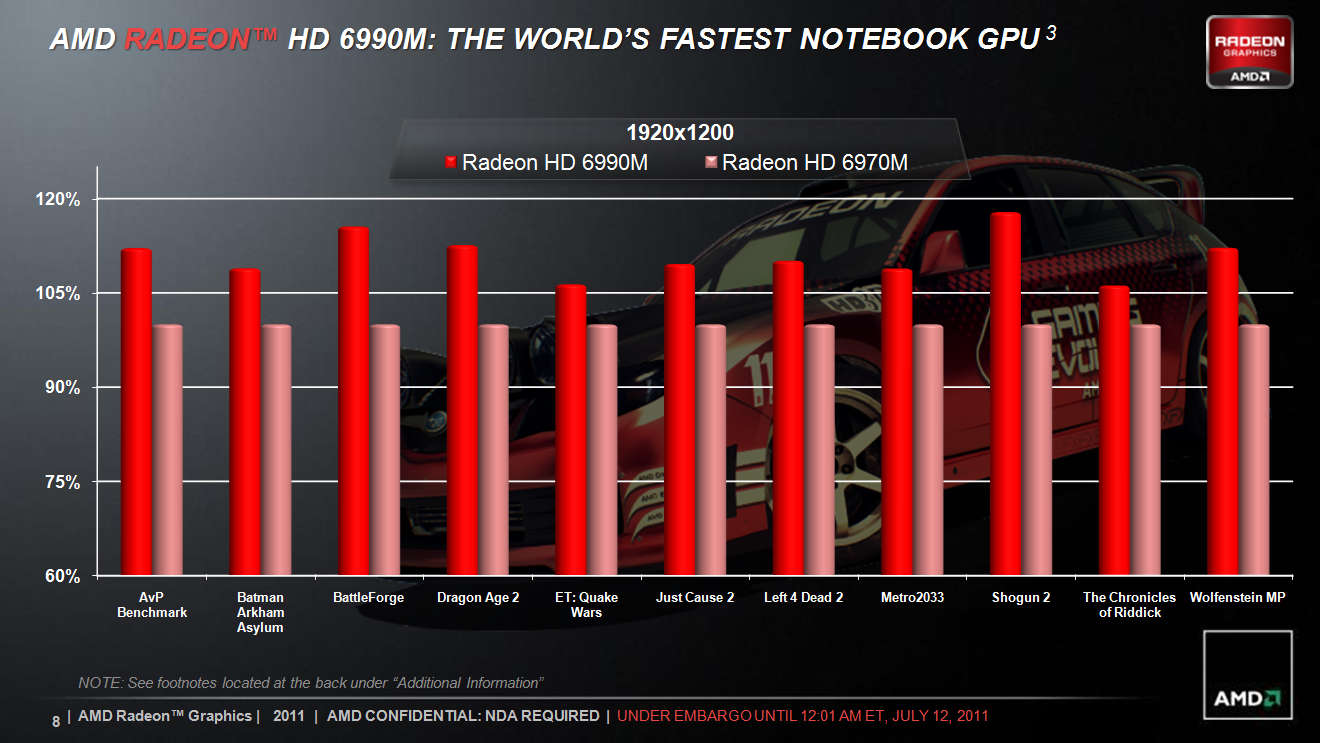
Looking at the mobile parts, the shader count gives the 6990M an immediate 17% boost in performance relative to the 6970M, and with a slightly higher cores clock as well (715MHz on the 6990M vs. 680MHz on the 6970M), we’re looking at up to 23% higher performance than the 6970M. Both the 6970M and 6990M continue to feature 3600MHz GDDR5 memory, although the 6990M comes with 2GB instead of 1GB. AMD also enabled OverDrive up to 740MHz for the 6990M if you want to try some quick overclocking. Here’s how performance between the AMD parts stacks up, according to AMD’s internal testing (using a desktop 3.4GHz Phenom II CPU):


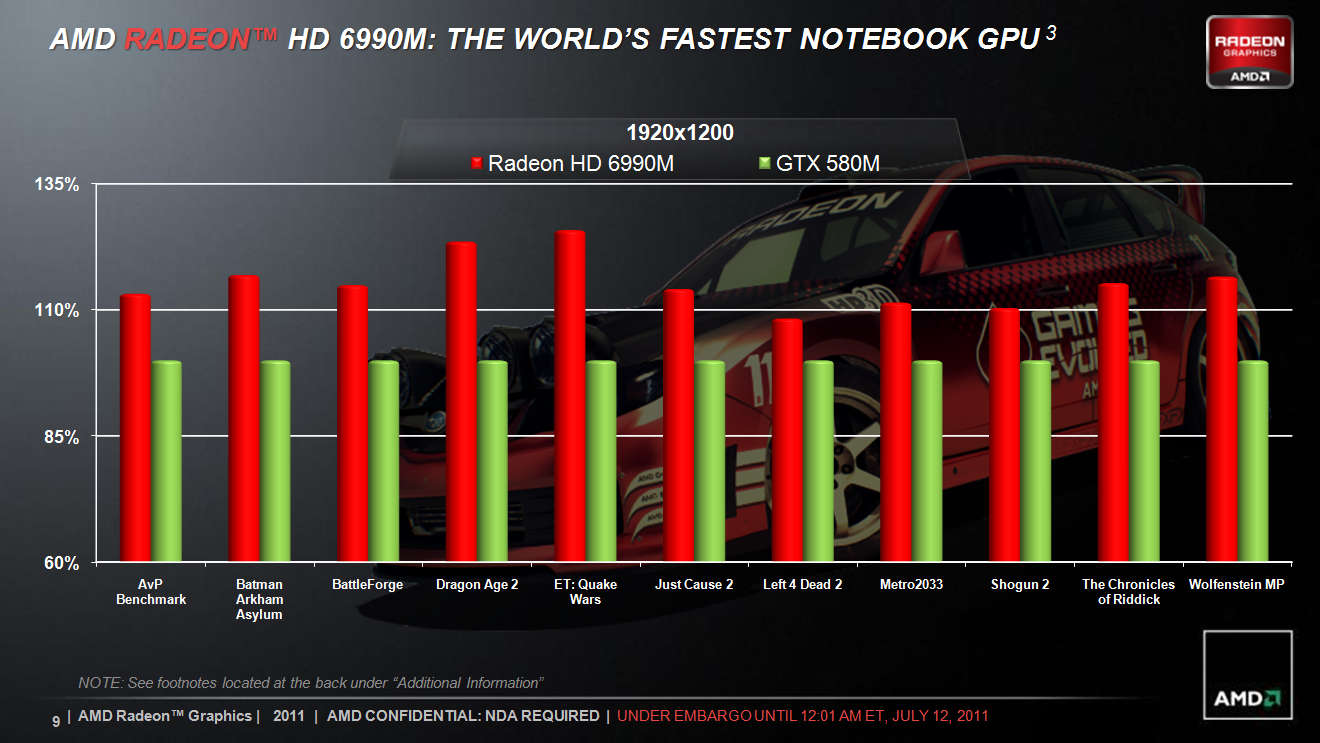
On the other side of the fence, NVIDIA’s GTX 580M has the same number of CUDA cores as the GTX 485M (384 cores), but with an 8% increase in clock speed. (The closets desktop equivalent is the GTX 560 Ti, which comes clocked 37% higher than the 580M.) Our earlier testing of the 485M and 6970M resulted in nearly identical average gaming performance across eight tested games, with both sides winning a few titles. In theory, then, HD 6990M should retake the mobile performance crown given the greater increase in compute and clock speeds relative to the second-tier parts. The following slide uses simulated performance (e.g. a downclocked desktop GTX 560 Ti GPU running at mobile speeds and with only 1GB GDDR5, again with a 3.4GHz Phenom II CPU), so take these results with a grain of salt:


Both the AMD and NVIDIA parts should be plenty fast for 1080p mobile gaming, so the real question is more likely to be who offers the best overall value. Sure, value in a gaming notebook is something of an oxymoron, but unless you absolutely need CUDA/PhysX support on the NVIDIA side or are looking at Bitcoin mining on the AMD side, performance is going to be close enough that pricing will sway the vote. Availability of the 6990M starts today, with the Alienware M18x coming in both single and CrossFire configurations. Clevo will also support the HD 6990M in their P170HM, P150HM, and X7200 notebooks, which means we’ll see whitebooks from the usual suspects like Eurocom, AVADirect, and others. Here's AMD's complete high-end mobile GPU lineup:

AMD Mobility Radeon 6800M and 6900M Lineup

Radeon HD 6990M Radeon HD 6970M Radeon HD 6950M Radeon HD 6870M Radeon HD 6850M
Model Name (Code Name) Blackcomb Pro (Barts) Blackcomb Pro (Barts) Blackcomb Pro (Barts) Granville Pro (Juniper) Granville Pro (Juniper)
Stream Processors 1120 960 960 800 800
Texture Units 56 48 48 40 40
ROPs 32 32 32 16 16
Core Clock 715MHz 680MHz 580MHz 675MHz 625MHz
Memory Clock 900MHz (3.6GHz) GDDR5 900MHz (3.6GHz) GDDR5 900MHz (3.6GHz) GDDR5 1000MHz (4.0GHz) GDDR5 1000MHz (4.0GHz) GDDR5
Memory Bus Width 256-bit 256-bit 256-bit 128-bit 128-bit
Memory Bandwidth 115.2GB/s 115.2GB/s 115.2GB/s 64GB/s 64GB/s
VRAM 2GB 1GB 1GB 1GB 1GB

As we've noted in the past, the 6000M consists of parts from both the Evergreen and Northern Islands series of graphics chips. For many users, the difference between the two isn't all that important, but Northern Islands does upgrade the video engine to UVD3 where Evergreen is UVD2.2. Also worth remembering is that the 6800M parts are really just renamed 5800M parts with slightly altered clocks in some cases, so they're not as attractive as the 6900M parts. Finally, the 6800M parts can come with either GDDR5 or DDR3, the latter being significantly slower and thus less desirable. Our table only uses the specs from GDDR5 variants, so if you're shopping for a 6800M make sure you get a GDDR5 model.

Outside of their newest mobile GPU, we also asked AMD about the current state of their switchable graphics on Intel platforms. AMD says they should have some partners releasing laptops with application based switching (e.g. similar to NVIDIA’s Optimus), but that will likely be with lower performance GPUs. In contrast, NVIDIA is touting Optimus support on certain GTX 580M configurations, though as always it’s up to the notebook vendors to utilize the feature. We haven’t had a chance to get hands on time with any form of AMD switchable graphics for some time, so the jury is still out. We hope to have an appropriate laptop for testing in the not-too-distant future, at which time we’ll be able to provide a better answer on which solution is the overall winner.
As for the question of who actually takes home the mobile gaming performance crown, we hope to have both GTX 580M and HD 6990M notebooks for testing in the coming weeks. On paper and using our previous 6970M and GTX 485M results, it looks like the 6990M should come out on top, but with various driver updates in the past several months we’re not ready to declare an official winner. If you’re looking for more than a few slides and potentially biased game selections, stay tuned: we’ll provide our usual in-depth look at real-world performance as soon as we can get hardware into our labs. Our money is still going to be on whoever can come in at a lower price point, and if recent history is any indication, that will likely be AMD with the 6990M. Update: Alienware now has both the GTX 580M SLI and HD 6990M CrossFire configurations available on their web site; at present, the SLI setup costs $700 more than the CrossFire configuration, which makes the 6990 an easy recommendation.

Unleash the full potential of AMD Radeon™ Graphics with GDDR5 ultra-fast memory

GDDR5 is the ideal GPU graphics memory for the mainstream mobile users to achieve the right balance of high performance and power consumption for the ultimate on-the-go visual experience. The added performance of the GDDR5 will be noticeable when playing with high resolutions and also high AA settings.

Monday, 11 July 2011

Budget Power Supply Disasembly and Review

Hey everyone, I haven't been on in a while and recently I have started to notice that there are not many reviews of budget power supplies on the internet. Maybe there are some hidden gems out there that haven't been found and reviewed yet. I am hopefully going to start doing little reviews showing what components are in each of these cheap power supply's and hopefully start reviewing a few. As my budget is tight it would be great if people could possibly donate cheap power supply's that are no longer needed for a review and disassemble. I will try and get hold of some cheap PSU's and start doing a few disassembly and find out what the quality of these cheap power supply's is like.

Jack-O-Bytes

Wednesday, 18 May 2011

Titanium-Free: Nvidia Introduces GeForce GTX 560

Nvidia Corp. this week quietly introduced a new performance-mainstream graphics processing unit (GPU) called GeForce GTX 560. The new graphics board offers lower performance compared to the GeForce GTX 560 Titanium released earlier this year, but is also available at lower price-point and improves speed of its predecessor.

"Starting at $199, the GeForce GTX 560 joins its big brother, the previously launched GTX 560 Ti GPU, in delivering an awesome gaming experience in its price class for games running at 1080p, the world's most popular gaming resolution, according to Valve's Steam Hardware and Software Survey," a statement by Nvidia reads.

Nvidia GeForce GTX 560 graphics card is based on the GF114 graphics processing unit (GPU), an improved version of the GF104 made using 40nm fabrication process with reduced power consumption and improved layout. The model GTX 560 has 336 stream processing units, 56 texture units, 32 render back ends, 7 tessellation engines and well as 256-bit memory controller. Nvidia recommends to clock the GF114 chip of 560 at 810MHz - 950MHz, which means that its stream processors operate at 1620MHz - 1900MHz. The designer recommends partners to install 1GB of GDDR5 memory clocked at 4GHz - 4.40GHz onto the GeForce GTX 560 graphics cards.
The novelty fully supports DirectX 11, OpenGL 4, OpenCL 1 as well as all the modern functionality, including hardware decoding of high-definition stereo-3D video and so on. In addition, the novelty supports Nvidia-exclusive features, such as CUDA-exclusive GPGPU software, PhysX and proprietary 3DVision stereo-3D feature.

Read More Here

Intel: There Are No Advantages in Going to ARM

Chief executive officer of Intel Corp. ruled out possibilities of adopting ARM architecture for its chips aimed at ultra-mobile devices. The company believes that instead of paying royalties to ARM, it may achieve better financial results and performance by tuning-up its x86 micro-architecture for low power consumption.
"There is no advantage going [into the ARM camp], we would be beholden to someone else, beholden to ARM. We would pay royalties to them so it would lower the overall profits. I think we can do a better," said Paul Otellini, chief executive of Intel, during the company's meeting with financial analysts, reports Reuters news-agency.
Back in 2010 chief technology officer of Intel indicated that the company's code-named Medfield system-on-chip powered by Atom x86 core and PowerVR graphics engine would be more energy-efficient than powerful ARM-based SoCs. The company promised in late 2010 that the first smartphones powered by Medfield would be available in the second half of 2011, but at present the firm expects handsets featuring x86 technology to be released in the first half of 2012.

Read More Here 

IBM to Help Oracle Customers to Adopt IBM Software, Platforms

Amid the uncertainties caused by Oracle's decision to stop developing software for Intel Itanium-based mission critical platforms as well as rumoured intention to cancel support for non-Oracle Linux distributives, IBM recently announced new migration resources to help Oracle software clients move up to IBM software. The company also claims that its DB2 software is more cost-efficient than competing solutions from Oracle.

The new resources include no-charge financial and technology assessments, skills training courses, and proof of concepts to support clients ready to convert their Oracle investments to the latest in IBM software.

As part of the support plan, IBM will provide detailed financial analysis that shows cost savings clients can achieve by switching from Oracle Database and'20Oracle WebLogic to IBM DB2 and WebSphere software. A no-charge, customized technical evaluation and conversion plan will show clients how fast and easy it can be to move up from Oracle to IBM software.

In addition, IBM will offer a no-charge, more than 100 online and in-person skills training courses to add certified DB2 skills to Oracle Database developer and database administrator teams, and WebSphere expertise to Oracle software teams.

Read More Here

Images, Details of AMD Fusion "Llano" Mainboards Transpire

EliteGroup Computer Systems (ECS) this week officially unveiled details about its mainboards designed for AMD A-series "Fusion Llano" accelerated processing units (APUs). In addition, the first picture of a high-end ECS motherboard for A-series chips emerged on the Internet.

ECS, one of the world's largest maker of motherboards, plans to release three A75F-series mainboards with FM1 socket for AMD code-named Llano A-series APUs. All three mainboards will be based on the AMD Hudson D3 (A75) Fusion controller hub (FCH), will support dual-channel DDR3 memory, PCI Express 2.0, Serial ATA-600, USB 3.0, high-definition audion and other advantages.

One of the mainboards - A75F-A "Black Deluxe - will be in ATX form-factor and will thus be aimed at more advanced end-users. For example, ECS A75F-A has passed 50°C burn test, presenting high quality and durability. In addition, based on the image of the mainboard that emerged on the Internet, the platform supports multi-GPU ATI CrossFireX technology which allows to install several discrete graphics cards, a feature typically found on high-end multimedia systems.

ECS A75F-A
The other two FM1 motherboards from ECS - A75F-M and A75F-M2 - will feature micro-ATX form-factor and will thus be aimed primarily at OEMs or system makers.

Read More Here