Saturday, 14 May 2011

John Carmack: Modern Graphics Cards from AMD or Nvidia are Insanely Powerful.

Legendary Video Game Designer Finds Pros and Cons of GeForce and Radeon Graphics Cards

John Carmack, a well-known developer of video games, believes that modern graphics cards by ATI/AMD and Nvidia Corp. are powerful enough to handle very complex games. However, the company that can better help game developers to optimize their games for their hardware will eventually automatically provide better solutions for those titles, Mr. Carmack believes.

“You almost cannot make a bad decision with graphics cards nowadays. Any of the add-in cards from AMD or Nvidia are all insanely powerful,” said John Carmack, the lead programmer at id Software, the game developer behind Doom, Quake, Wolfenstein and other popular title, in an interview with PC Gamer web-site.


Even though Mr. Carmack does not give any recommendations for buyers, he claims that the hardware from a vendor that better supports game designers can potentially offer better solutions to end users.

Read More - http://www.xbitlabs.com/news/multimedia/display/20110513155252_John_Carmack_Modern_Graphics_Cards_from_AMD_or_Nvidia_are_Insanely_Powerful.html

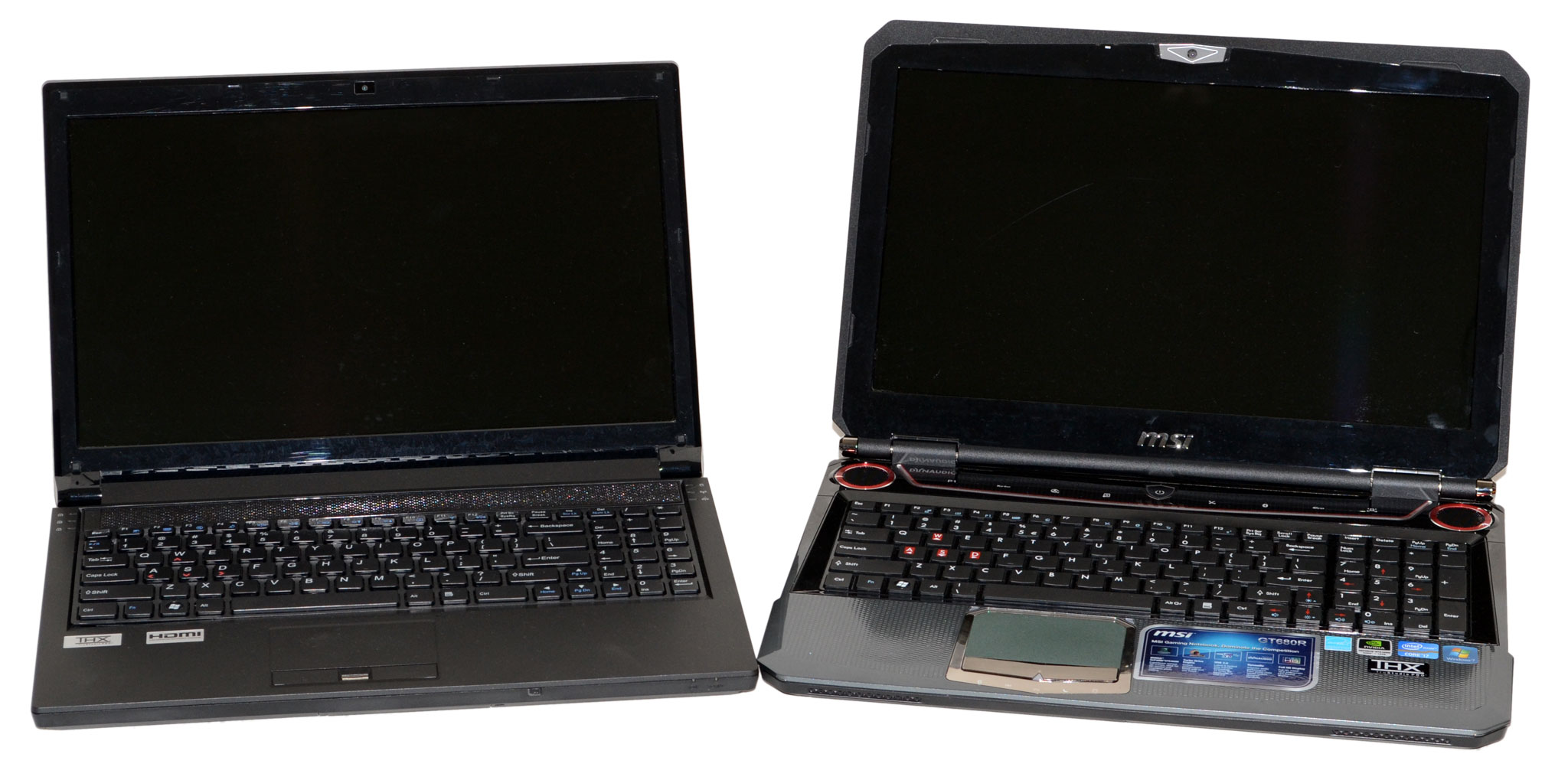
CyberPower's X6-9300 and MSI's GT680R: Fighting for Your Mobile Gaming Dollar

The Fight for Your Mobile Gaming Dollar

At a macro level, there really aren’t all that many viable gaming notebook options. These days, Sandy Bridge processors rule the roost in notebooks, with the quad-core variety handling everything from single-threaded to multi-threaded workloads with aplomb. On the graphics side, you can try to get by with midrange mobile GPUs, but if you’re serious about mobile gaming you’ll want at least something from NVIDIA’s GTX line or AMD’s 6900M alternatives. Take the CPU and GPU; match them up with reasonable memory, storage, display, and other accoutrements; and you’re all set. That all works very well in the desktop world, even if it glosses over many of the finer points that separate the contenders from the pretenders. In the mobile world, however, the little things matter.

Modern computers are very modular by design. We have standards for power, memory, storage, and peripherals and you can generally choose what fits your needs. With notebooks, however, a lot of flexibility gets sacrificed in the name of making a reasonably sized chassis. Not coincidentally, profit margins tend to be quite a bit higher for notebooks than desktops, which is why so many companies want a piece of the pie. While it’s still pretty easy to upgrade memory and storage options, swapping out the CPU for something faster is more difficult and you need to make sure the cooling setup can handle any additional heat. Upgrading your GPU on the other hand is difficult at best, and frequently impossible. The issue with mobile GPUs is that despite MXM being something of a standard, chip locations are left up to the implementation, so there’s no guarantee that, for example, an HD 6770M could be installed in place of a GT 540M. And as far as the LCD, keyboard, touchpad, motherboard, and chassis are concerned, you’re stuck with whatever you buy with no chance of upgrading individual parts in the future. (Okay, perhaps you could upgrade the LCD panel in some cases, but you get what we’re saying.)

Friday, 13 May 2011

OCZ Technology Reveals Mainstream SSDs with Serial ATA-600 Interface.

OCZ Technology Group this week released two new families of solid-state drives with Serial ATA-600 interface and relatively low price. The new Agility 3 and Solid 3 drives feature SandForce SF-2200-series controller and provide maximum read speed of around 500MB/s, which is tremendous speed for mainstream solid-state drives.

Both OCZ Agility 3 and OCZ Solid 3 are based on multi-level cell (MLC) NAND flash memory made using 20nm-class process technology, are powered by SandForce SF-2281 controller, support TRIM technology, use Serial ATA-600 interface. The drives have similar 2.5" form-factors, weights, operating temperatures, power consumption, shock resistance and so on. Both drives feature ECC capability with up to 55 bits correctable per 512-byte sector. The main difference between the two drives is much higher IOPS [input/output operations per second] performance of Agility 3 compared to Solid 3, which may be conditioned by firmware.

“With increased availability of SATA III platforms, the demand for the latest generation SSDs has grown rapidly. We are addressing this demand with new products that offer both the best performance and value for consumers. The new Agility 3 and Solid 3 SSDs make it easier than ever for consumers take advantage of the new SATA III interface. When coupled with the speed and reliability benefits that our SSDs offer over traditional hard drives, it makes the two new series the ideal choices for mobile and desktop applications," said Ryan Petersen, chief executive officer of OCZ technology Group.
 

Intel Debuts New Enthusiast-Class Core-Logic Set with SSD-Based Caching Technology.

Intel Corp. this week released a new enthusiast-class platform for its latest Core i-series "Sandy Bridge" microprocessors. The platform is powered by the new Z68 core-logic set along with 311-series "Larsen Creek" solid-state drive (SSD) that speeds up typical workloads by working in companion with a hard disk drive (HDD).
"The Z68 chipset offers new overclocking and caching features for PC enthusiasts who want more control over their [...] desktops. The 20GB Intel SSD 311 is optimized for the new Intel Smart Response Technology caching feature in Z68 which helps speed boot times, application loads, and many other PC uses," said Daniel Snyder, a spokesman for Intel.
 

Nvidia Has No Immediate Plans to Integrate Baseband Capabilities into Tegra.


Nvidia Corp., which acquired Icera baseband processor designer earlier this month, said that it had no immediate plans to integrate baseband capabilities into its Tegra system-on-chip devices for handsets as well as tablets. Instead, Nvidia plans to bundle Tegra with Icera baseband processors and thus provide two of the key chips for mobile devices.
"With respect to the integration, we have no current plans to integrate [Icera's] modem. We think that the ability to offer both processors and either the two most important processors for mobile computing gives us the opportunity to leverage the momentum of Tegra and also the quite broad penetration [Icera] have already achieved with carriers all over the world to increase the momentum of both processors," said Jen-Hsun Huang, chief executive officer of Nvidia, during the quarterly conference call with financial analysts.
Previously Nvidia insisted that its intentions with Tegra included only high-end devices which do not require high levels of integration, but need maximum performance and rich feature-set. In fact, according to Nvidia, so-called super-phones and tablets do not combine application and baseband processors on the same chip; which is correct, for example, Apple's A4 and A5 SoCs that power iPhone 4/iPad and iPad 2 do not have baseband capabilities.

Read More - http://www.xbitlabs.com/news/multimedia/display/20110513110907_Nvidia_Has_No_Immediate_Plans_to_Integrate_Baseband_Capabilities_into_Tegra.html

Z68 SSD Caching with Corsair's F40 SandForce SSD

I have to admit that Intel's Z68 launch was somewhat anti-climactic for me. It was the chipset we all wanted when Sandy Bridge first arrived, but now four months after Sandy Bridge showed up there isn't all that much to be excited about - save for one feature of course: Smart Response Technology (aka SSD caching). The premise is borrowed from how SSDs are sometimes used in the enterprise space: put a small, fast SSD in front of a large array of storage and use it to cache both reads and writes. This is ultimately how the memory hierarchy works - hide the latency of larger, cheaper storage by caching frequently used data in much faster, but more expensive storage.
I believe there's a real future with SSD caching, however the technology needs to go mainstream. It needs to be available on all chipsets, something we won't see until next year with Ivy Bridge. Even then, there's another hurdle: the price of the SSD cache.
For $110 today you can either get a 20GB Larson Creek drive from Intel, or a 40GB SF-1200 based SSD from Corsair. Given how well SandForce's SSDs perform on their own, I wondered how one would stack up as a SSD cache

Intel's Silvermont: A New Atom Architecture

Brooke Crothers broke a very important story today - he published the name Silvermont. Atom's first incarnation came to us in 2008 as a Pentium-like dual-issue in-order microprocessor. The CPU core was named Bonnell, after the tallest point in Austin at around 750 feet. Small mountain, small core. Get it?
Bonnell and the original Atom were developed on a 5-year cadence, similar to how Intel ran things prior to the Core 2 revolution (the P6 to Netburst/Pentium 4 move took 5 years). With the original chip out in 2008, five more years would put the next major architecture shift at 2013, which happens to be exactly when the Cnet report mentions Silvermont will be introduced.

When I first met with the Atom design team they mentioned that given the power budget and manufacturing process, the Bonnell design would be in-order. You get a huge performance boost from going to an out-of-order architecture, but with it comes a pretty significant die area and power penalty. I argued that eventually Intel would have to consider taking Atom out of order, but the architects responded that Atom was married to its in-order design for 5 years.

Intel's Moorestown - same Atom core, just more integrated

Since 2008, Atom hasn't had any core architecture changes. Sure Intel integrated the GPU and memory controller, however the CPU still communicates with both of them over an aging FSB. The CPU itself remains mostly unchanged from what we first saw in 2008. Even Intel's 32nm Atom due out by the end of this year doesn't change its architecture, this is the same dual-issue in-order core that we've been covering since day 1. The 32nm version just runs a bit quicker and is paired with a beefier GPU.
Silvermont however changes everything. It is the first new redesign of the Atom architecture and it marks the beginning of Atom being on a tick-tock cadence. Say goodbye to 5 year updates, say hello to a new architecture every 2 years.

Read More - http://www.anandtech.com/show/4333/intels-silvermont-a-new-atom-architecture

HTC HD7: Now With NoDo


When Microsoft launched Windows Phone 7 late last year, it was readily evident that they had a solid platform on their hands, but it was missing some critical details. Chief among them? Copy-and-paste, bringing back a frequent grievance from the early iPhone days. The platform’s first update, codenamed “NoDo” (there’s a story behind that), is now out, with copy-paste support in tow, along with much improved application loading and some general performance tune-ups in the UI.

At the same time, we decided to take a look at HTC’s HD7, since it’s been my day-to-day phone for a couple of months now. It’s still the only Windows Phone you’ll find in a T-Mobile store, so it’s worth taking a look at, especially now that a very similar variant is due to hit AT&T in the coming weeks.
Read on for our thoughts on both the HD7 and Microsoft’s new update to the Windows Phone platform.

Read More - http://www.anandtech.com/show/4300/htc-hd7-now-with-nodo

Sunday, 13 February 2011

AMD Plans Extremely Rapid Transition to New Micro-Architectures, Process Technology.

Advanced Micro Devices seems to be planning extremely rapid transition of its desktop microprocessors to 32nm silicon-on-insulator fabrication process, a person with knowledge of the matter said. By the second quarter of 2012 virtually all AMD processors will be made using 32nm SOI technology and be based on new designs.

At present the absolute majority of desktop microprocessors shipped by Advanced Micro Devices are AMD Athlon II and AMD Phenom II chips in AM3 form-factor. But already in a little bit more than a year from now all the desktop chips that AMD will sell will be made using 32nm SOI process technology and will rely on code-named Bulldozer, Brazos and Llano designs, the source indicated.

Approximately 20% of AMD's desktop microprocessors in Q2 2012 will be in AM3+ form-factor and will belong to the FX family of chips, which is based on Bulldozer micro-architecture. About 10% of desktop chips will come in FT1 ball-grid-array form-factor and will therefore be based on Brazos design. The remaining 70% will be Llano accelerated processing units with two or four x86 cores as well as a Radeon HD 6000-class graphics engine in  FM1 form-factor.

It is remarkable that after a number of delays AMD seems to have rather ambitious plans for the 32nm ramp. By contrast, it usually takes years for Intel Corp., the much larger rival of AMD, to transit to one micro-architecture to another or from one technology process for another.

AMD did not comment on the news-story.

www.customdesktops.moonfruit.com
http://www.xbitlabs.com/news/cpu/display/20110211103809_AMD_Plans_Extremely_Rapid_Transition_to_New_Micro_Architectures_Process_Technology.html

Sony Lawyers Going To The Limits: Threaten To Sue Anyone Who Posts PS3 Jailbreak Code

As of Friday, Sony is threatening to sue anybody posting or “distributing” the first full-fledged jailbreak code for the 4-year-old PlayStation 3 gaming console.
What’s more of an extreme measure, the company is demanding that a federal judge order Google to surrender the IP addresses and other identifying information of those who have viewed or commented about the jailbreak video posted on the YouTube page. Sony is also demanding Twitter to provide the identities of a host of hackers who first unveiled a limited version of the hack in December (Referring to the fail0verflow team here)


Sony’s aggressive pretrial discovery demands come in its lawsuit against Geohot (George Hotz). The 21-year-old New Jersey hacker, who is well known in the jailbreaking community for making jailbreak programs for Apple’s iPhones, published the finished PlayStation 3 code and a how-to YouTube video last month. The code enables the Playstation 3 to play pirated and homebrewed games.